
By Milan Paurich
There are directors who become respectable, and then there are directors who refuse respectability even after the culture has decided they’re Important. Paul Thomas Anderson has been carrying around the burden of importance for 25 years now, and every so often it’s threatened to flatten him. There Will be Blood was magnificent but monumental in a way that invited solemn admiration. The Master had a hypnotist’s confidence in its own mysteries. Even the exhilarating Licorice Pizza was treated like the work of a beloved master relaxing into nostalgia.
One Battle After Another blows that all away. It’s a movie that behaves as if Anderson suddenly remembered that the camera is a toy before it’s an altar.
You walk into the theater expecting another American epic–something measured, prestigious, probably overdetermined–and instead the picture leaps at you sideways. It’s funny in odd places. It lunges into violence without warning. It allows conversations to wander into absurdity before snapping into emotional focus. It keeps changing rhythms until you’re no longer watching for plot points but for sensations. You don’t sit back and admire it, it keeps grabbing your sleeve.
American directors almost never permit themselves this kind of freedom anymore. They’re terrified of looking messy. Anderson has made a gloriously messy film that somehow possesses the hidden architecture of a Bach fugue.

The title sounds like a slogan from some forgotten revolutionary tract, and that’s about right. The movie is haunted by the debris of sixties radicalism–not sentimentally, as something noble that has been betrayed, but as emotional wreckage people carry inside them long after the banners have rotted away. The characters have survived history, but history hasn’t stopped vibrating inside their nervous systems.
That’s what Anderson understands better than almost anybody making movies today. The past isn’t exposition. it’s muscle memory.
Leonardo DiCaprio has always been an extraordinary actor, but gifted actors often become prisoners of their own virtuosity. They demonstrate feelings rather than discovering them. Here Anderson has somehow broken DiCaprio loose from the habits of “Great Acting.” The performance has an astonishing looseness. DiCaprio stammers, hesitates, panics, doubles back on himself. His face seems to invent reactions faster than his mind can organize them. He’s funny because fear is funny, and moving because vanity keeps collapsing into bewilderment. Watching him, I thought of the young Robert De Niro before he became an institution.The performance isn’t polished, it’s alive.
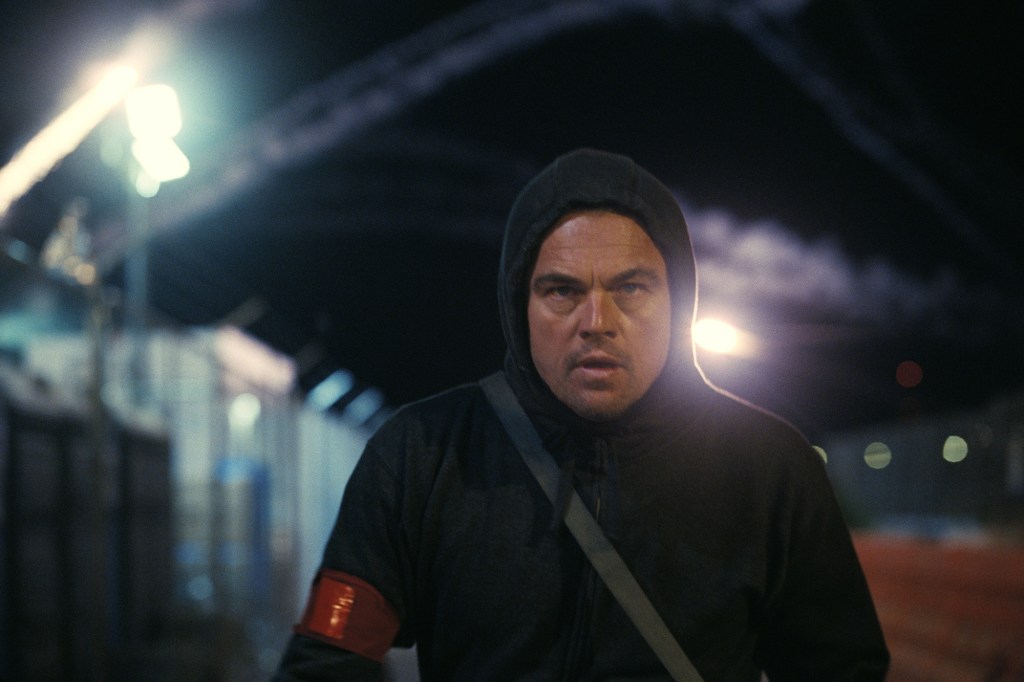
Sean Penn, who lately seems determined to petrify himself into granite, discovers a wonderfully dangerous comic edge. Benicio Del Toro barely appears to be acting at all. He’s become one of those extraordinary screen presences like Lee Marvin or Warren Oates whose gravity bends every scene around them. Regina Hall has an emotional directness that cuts through Anderson’s elaborate orchestration like a trumpet solo in the middle of a symphony. Teyana Taylor has the kind of confidence before the camera that makes you suspect she could have been a star in almost any decade. The casting feels less like Hollywood packaging than repertory jazz. Anderson has always loved actors, but here he’s listening to them instead of arranging them.
What’s exhilarating isn’t simply the performances but the way they’re photographed. Contemporary filmmaking has become obsessed with coverage. Directors shoot conversations the way accountants keep ledgers, carefully preserving every possible option for the editing room. Anderson still believes in discovering dramatic shape through movement. His camera glides, not because gliding is beautiful (although it is). It glides because curiosity moves. The camera wants to know what another face is doing. It wants to drift toward a gesture, then abandon it for something happening in the background. It behaves like an intelligent spectator whose attention keeps shifting because life keeps shifting.
People talk about “long takes” as if duration were automatically expressive. Duration isn’t expressive, attention is. That’s why Anderson’s camera is never showing off. Even when it’s executing elaborate choreography, the movement has the spontaneous elasticity of thought itself.

Some directors illustrate screenplays, but Anderson directs emotional weather. You don’t remember scenes as dramatic units so much as atmospheres you’ve wandered through. A room can suddenly become hysterically funny because somebody scratches his neck at exactly the wrong moment. Terror arrives not through music but through silence. A joke mutates into heartbreak before you’ve realized the joke has ended. The movie keeps refusing the emotional punctuation Hollywood has trained us to expect. No underlining, no exclamation points, just accumulation.
The odd thing is that One Battle After Another is, in many ways, Anderson’s funniest film. His comedy has become stranger with age. It isn’t built around punchlines, it’s built around people failing to synchronize with reality. Characters enter scenes carrying completely different emotional temperatures. One person thinks the conversation is about politics, another thinks it’s about love, a third thinks somebody is trying to kill him. The resulting collisions produce laughter that feels almost neurological. I found myself laughing before I understood why. Most contemporary comedies ask permission for every laugh while Anderson simply lets absurdity happen.
The picture also contains action sequences of startling force, not because they’re spectacular but because they’re spatially intelligible. You always know where everyone is. Modern action movies mistake confusion for excitement. Anderson understands that excitement depends upon clarity. Once you know where bodies exist in relation to one another, violence regains its moral weight. Every gunshot changes the emotional geometry of the room. That used to be basic filmmaking; now it feels revolutionary.
The film’s politics are elusive enough to irritate both left and right, which is probably healthy. Anderson isn’t making arguments about ideology. He’s fascinated by what ideology leaves behind after history has exhausted itself. His radicals, opportunists, government men and drifters all seem trapped inside stories they’ve inherited without entirely believing them. Nobody wins debates. People merely survive them. Perhaps that’s why it feels unexpectedly moving.
For all its manic energy, it’s finally about aging–not physical aging but historical aging. What becomes of people who once imagined themselves participating in history and discover they’re simply living through time like everybody else? That’s an unusually painful question for an American movie. Hollywood generally assumes every generation begins the world anew. Anderson remembers that people drag entire eras around inside themselves.
Some have complained that the film is too sprawling, too eccentric, too unwilling to explain itself. I suspect those complaints are accurate in the narrowest sense and completely beside the point. Movies don’t have to solve themselves, they have to possess us. This one does.
Walking out of the theater last September, I wasn’t thinking about themes or symbols or where it ranked in Anderson’s oeuvre. I felt physically exhilarated: the peculiar light-headedness that comes after encountering an artist who has somehow enlarged your sense of what films can do. That’s become an uncommon sensation. Too many gifted directors now make movies that require admiration. Very few make ones that generate intoxication.

Robert Altman did it with Nashville. Martin Scorsese did it with Taxi Driver. Francis Ford Coppola did it with Apocalypse Now. They weren’t simply making good pictures. They were releasing new currents of energy into the bloodstream of the medium. You left the theater feeling that film itself had become younger. Watching One Battle After Another, I had that feeling again. Anderson isn’t borrowing from the American cinema of the seventies, he’s reminding us why it mattered in the first place.
Some directors mature into elegance. The lucky ones mature into recklessness. Paul Thomas Anderson has become reckless again, and American movies are suddenly alive enough to surprise us.
-30-
Movie-crazy from an early age, Milan Paurich grew up in Northeastern Ohio at the tail end of the Movie Palace era. Some of his earliest memories involve sitting in the balconies of downtown “Cathedrals of Cinema” and watching Mary Poppins, In Search of the Castaways, and The Three Stooges Go Around the World in a Daze for the first time.
Milan ultimately took his incipient cinephilia to New York University, where he graduated with a double major in Cinema Studies and Journalism.
He has been a professional film critic for several decades at daily newspapers, alt-weeklies, and on television.
Milan also won three S.P.J. (Society of Professional Journalists) awards as “Best Critic in Ohio.”
Updated weekly, his MIX 98.9 film and home video reviews appear online here: https://movieswithmilanmix989.com/.



Leave a comment