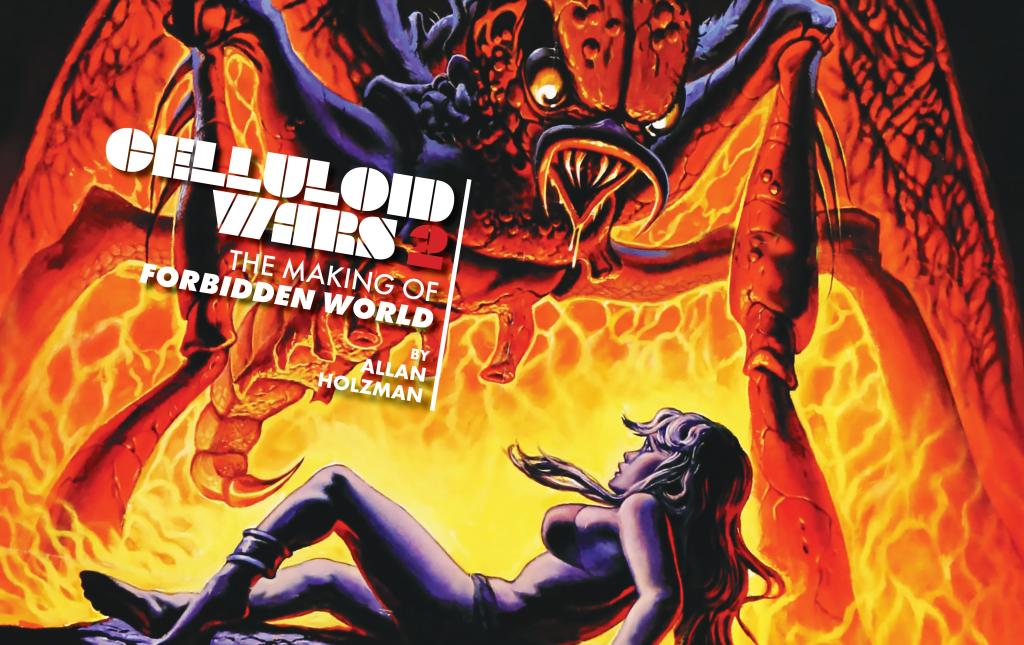
An interview with Allan Holzman, director of Forbidden World and writer of the new book Celluiod Wars 2: The Making of Forbidden World
By James Kenney
Right off the bat, any serious filmgoer knows sequels are almost never any good. For every The Godfather Part II or Before Sunset, there is attenuated crap like Arthur 2, The Sting II, Miss Congeniality 2 or Beverly Hills Cop II, which people still try to convince me is a good movie because superficial hack Tony Scott makes all the characters yell incessantly and uses gels on everything to distract us from the fact that he hasn’t a clue about comedy .
But I have come across one sequel that equals the original. Transcends it, even.
And that is Allan Holzman’s book Celluloid Wars 2: The Making of Forbidden World. Holzman, a filmmaker, editor and writer, was interviewed by me upon the release of his first book, detailing his time as an editor on Roger Corman’s New World Pictures low-budget answer to Star Wars, Battle Beyond the Stars. It was an unusually open and honest account of the good and bad of that production, based on detailed journals he kept at the time – I’m not sure when the man ever sleeps – in a gorgeously produced book overloaded with rare images and materials detailing the making of the film.
But what Holzman really wanted to do was direct.
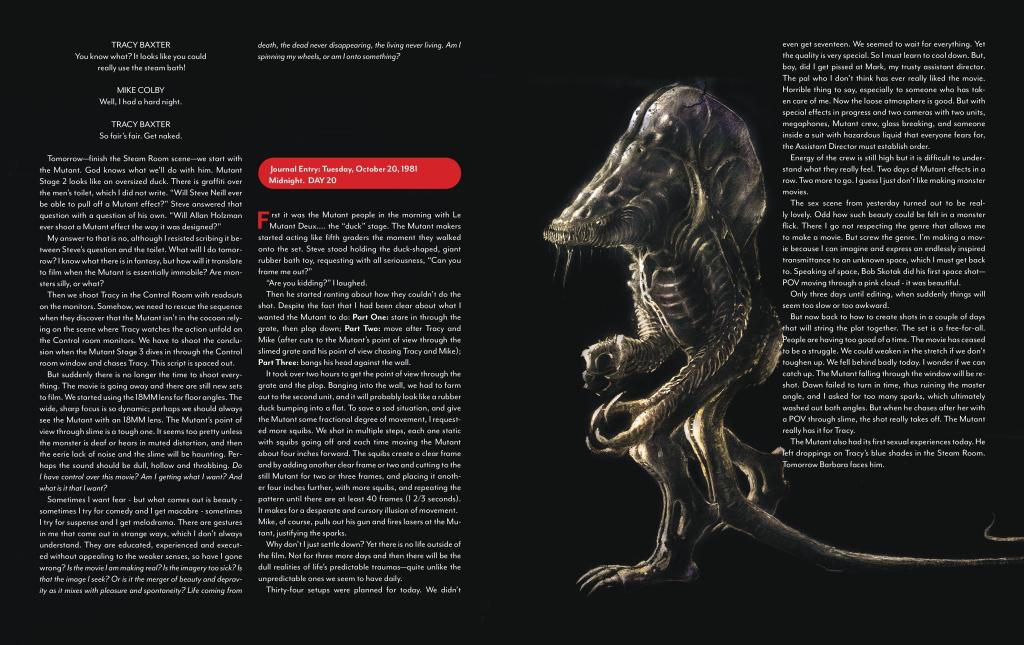
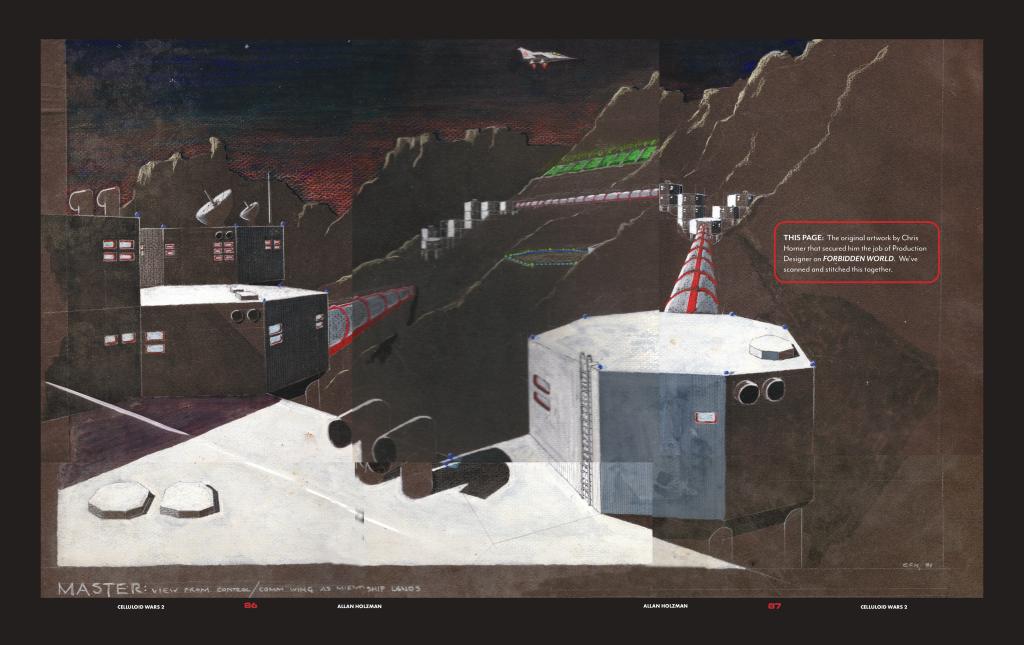
So of course – and thank God – he kept journals during the making of this one, too. The result is my favorite film book of 2026: a book that unveils how New World Pictures and Roger Corman really worked, explains the nuts and bolts of directing for the studio and the anxieties and personality clashes that come with it, and shares gorgeously reproduced on-set photos, script pages, artists’ concept artwork and more in detail I don’t think is easily matched by any other book of recent memory (save Holzman’s first book in this series).
I promise that, like Holzman’s book itself, this article will equal or surpass the first article I did with him, which was pretty damn good. And if you love filmmaking, are fascinated by low-budget filmmaking and Roger Corman’s world in particular and want to get inside the mind of an artist trying to create something unique and special – but also filled with violence, gore and sex, on no budget and with crazy, unpredictable actors – this is the book for you.
This is less a conventional making-of than a contemporaneous diary of a first-time feature director discovering, almost hour by hour, what directing actually means while working inside Roger Corman’s brutally economical filmmaking machine. Corman comes off “worse” here than in almost any other detailed discussion of how things worked at New World, and the image feels truer than any previously relayed. To be clear, Holzman loves him, too, and writes a touching memorial to Corman in the book; Corman died while Holzman was writing it.
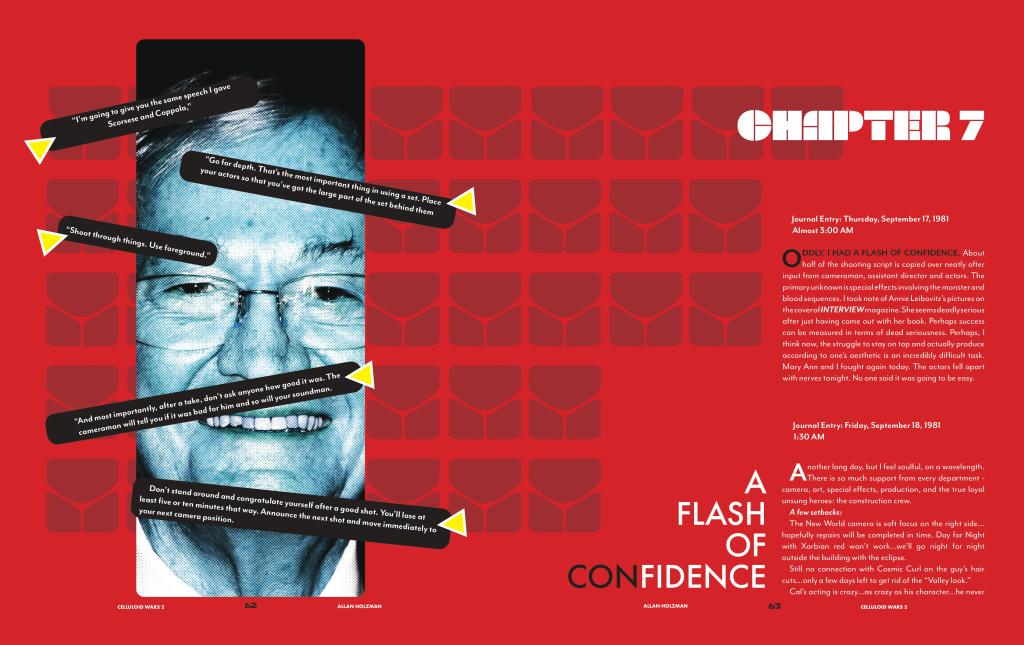
But we see Corman’s mercurial temper and sometimes capricious, parsimonious nature in full bloom alongside his genuinely giving spirit. The filmmaking advice he gives Holzman (shared in the book) is invaluable, and one cannot understate that his system allowed many great filmmakers – from Scorsese to Bogdanovich to Cameron to Holzman himself – to flower. This imperfect image is fascinating to behold. It was an independent studio, and the issue wasn’t about wasting money; it was about wasting his money, which he could not abide and would prove generally intransigent about.
Holzman isn’t reconstructing his feelings forty-five years later and giving every disaster the comforting shape of an anecdote. Most of the book comes from entries written while he honestly does not know whether the movie will turn out well – or at all – whether the monster will work, whether the actors will cooperate, or whether Corman is going to abruptly fire a key crew member midjob just to save a little. The more recent interviews with people who worked alongside him on the film (such as Jim Wynorski, star Jesse Vint, and Holzman’s wife, Susan Justin, who did the score) and his own reflections allow the older, wizened filmmaker to revisit what the younger filmmaker couldn’t yet understand, but Heather Wixson’s foreword correctly identifies the diaries as the book’s backbone and the source of its unusual immediacy.
A lot of books about filmmaking tell you how a movie was made. Holzman’s book shows you what it felt like to have a dream and an opportunity, but not yet know exactly how to make one, and learning through the process.
Becoming a Director
JAMES KENNEY: When you reread the diary now, do you recognize the 34-year-old man who wrote it – or does he sometimes seem like another person?
ALLAN HOLZMAN: Not only do I recognize him; in all actuality, I’ve not stopped living it. Almost as if caught in a vacuum, my senses cling to every moment. I’ve yet to live as free as an artist as I did then. Passion was my guide. The only end was acceptance. Approval. Love. Joy in expression of one’s work. The right to keep going. To create a body of work.
The story really begins before Forbidden World. Holzman is already an editor at New World, has directed a short, has ambitions considerably larger than his current position, and has had painful experiences trying to convince producers to let him direct. The section concerning Holzman’s stutter is key because it changes the meaning of everything that follows. Holzman remembers executive Sean Daniel apparently concluding that somebody who had difficulty getting words out couldn’t possibly command a film crew; another attempted pitch, to Peter Bart, becomes an excruciating fifteen-minute struggle in which Holzman eventually resorts to reading from his treatment.
That’s not a peripheral autobiographical detail. It gives the eventual Corman story real emotional weight. Holzman’s ambition isn’t merely, “I want to move from editor to director.” It’s also: “I want the job that requires me to stand in the middle of dozens of people and communicate constantly.”
JAMES KENNEY: You weren’t just trying to direct a movie; because of your stutter, directing demanded exactly the kind of constant verbal communication that had sometimes been difficult or humiliating for you. Did directing change your relationship to your stutter?
ALLAN HOLZMAN: My relationship with stuttering is so strong nothing will ever disturb it. I tried my best never to be humiliated. I never felt it was my fault, that I could have done better. I always tried my best not to stutter. It was more of a battle than isolated incidents of embarrassment. But embarrassing as stuttering is, humiliation is a feeling that I never welcomed.
Of course, there were times when I was totally humiliated. The biggest, of course, is not being able to say the most important word of my career when I asked Roger – or rather tried to ask Roger – if I could direct. But the humiliation of that moment led to the writing of this book. Writing empowered me, kept me believing in me. So I never once on the set lacked confidence. I may have stuttered more than I can remember but, as I told Roger, it was in the act of communicating, which everyone around me appreciated. Also, I had the feeling almost all the time that everyone liked me. I certainly was prepared, so that gave me confidence. Also, I did not seek approval. Roger had veto power, but I had an open field for creativity as long as I did not exceed the budget and maintained a constant course of staying ahead of schedule – even though we were always behind, since there was never any time and we were preparing a movie with a story but not a script.
The Test
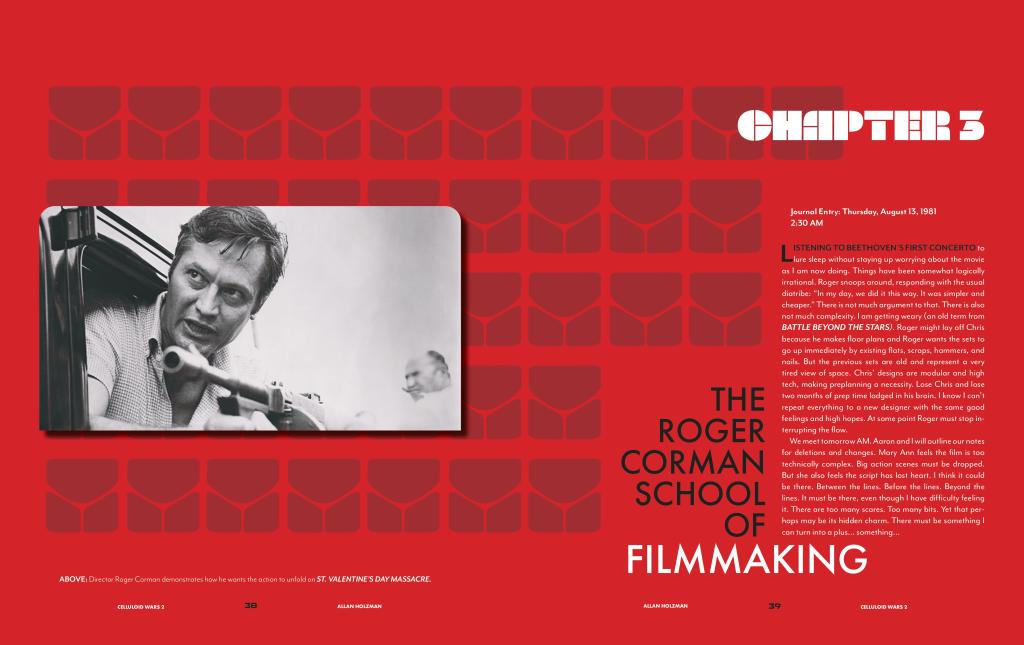
Holzman had edited Battle Beyond the Stars and had already worked his way through what Corman himself describes as the Roger Corman School of Filmmaking – (see my previous interview with Holzman for details). The assignments escalate: second-unit work; writing, directing and editing additional material; then finally, a test.
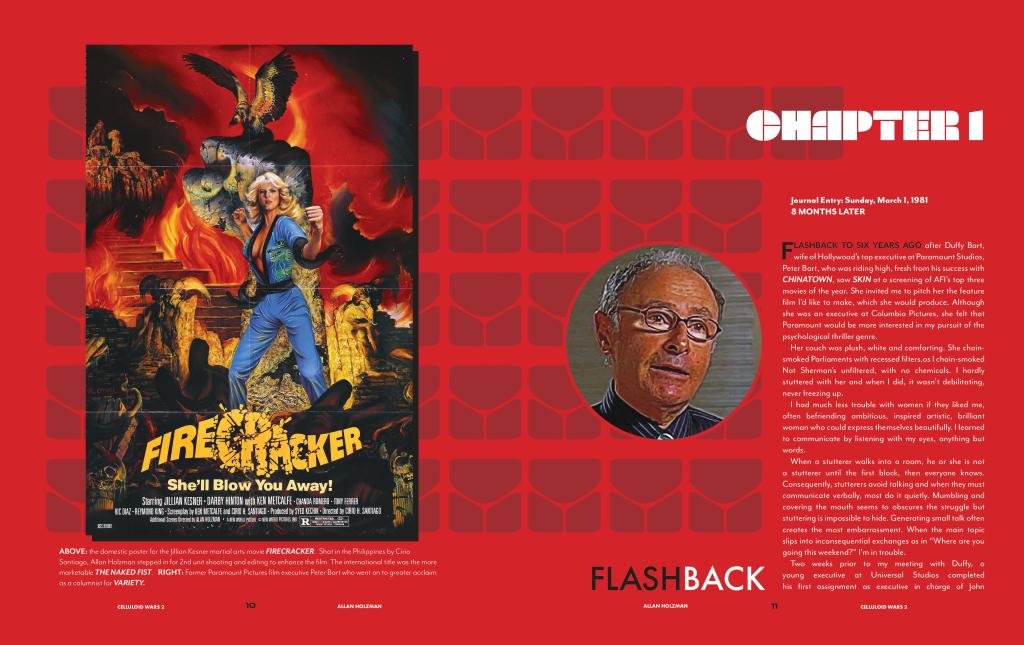
After Holzman successfully directs a sequence of Corman’s karate flick Firecracker (and indeed, it’s the sequence everyone remembers from the film), Corman asks Holzman if he wants to direct an entire movie. Then he tells him that the spaceship set from Galaxy of Terror, a science-fiction horror movie that had just finished filming, will be available for one day. Holzman has an opportunity to shoot a self-contained sequence for a science-fiction movie that can lead anywhere. Corman gives him an astronaut, actor Jesse Vint from Macon County Line, a robot and, as inspiration, the idea of doing Lawrence of Arabia in space.
Holzman pulls it off. The shoot involves twenty-three setups, rear projection, effects and camera movement, done after virtually no sleep. Five days after Corman first proposes the exercise, Holzman finishes filming; a week later Corman likes the cut and tells him to proceed with the feature.
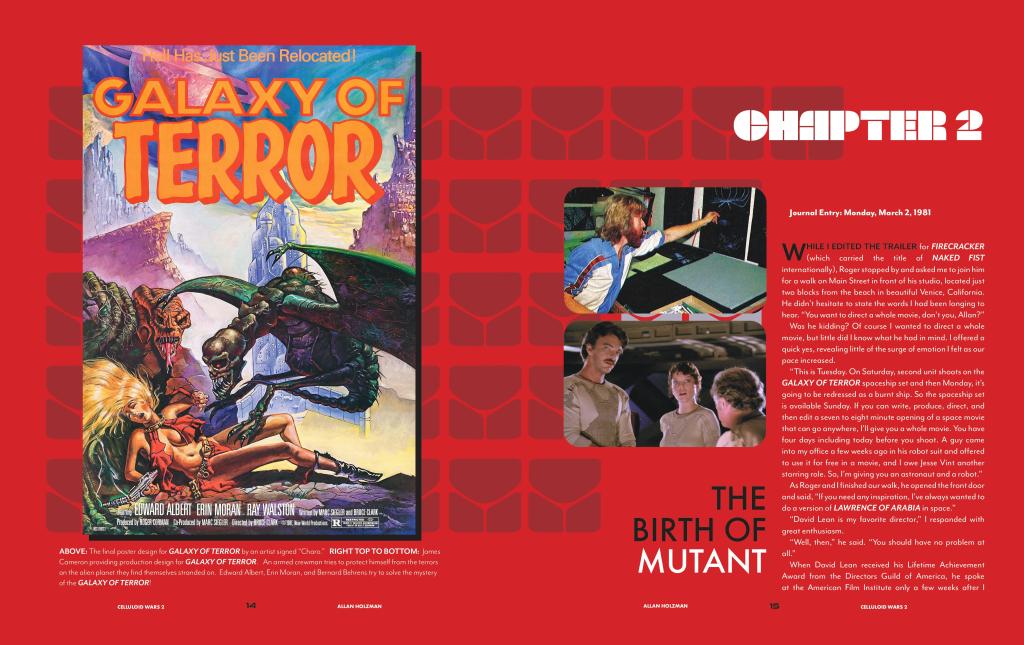
Then comes one of the book’s great punchlines. After Holzman develops several treatments inspired by Lawrence of Arabia, Corman finally pounds the desk and effectively says: Forget this approach. Just make another rehash of Alien (Galaxy of Terror, the film that World borrows sets from, was an Alien rehash itself).
JAMES KENNEY: Roger begins by telling you to think of Lawrence of Arabia in space and shortly thereafter tells you, essentially, to rip off Alien. Is the distance between those two instructions the entire Roger Corman experience?
ALLAN HOLZMAN: The entire Roger Corman experience is a funny term. My Roger Corman experience goes from Candy Stripe Nurses to Werner Herzog’s Fitzcarraldo. I put my heart into editing the trailer for this truly amazing movie experience. I used the opera as my music and narrative guide and utilized subliminal editing to heighten the production value of the trailer, to add movement and action. Roger supported my subliminal editing, timed to the opera swells, as a fairly inexpensive way to generate “special effects.” One- and two-frame cuts, especially rapid ones, cannot go through the printer, so each frame must be rephotographed on an optical bench. Roger had a flat-rate arrangement with Jack Rabin, special-effects hero of the fifties, to do the opticals. Jack committed to covering the costs just to keep Roger as a steady client.
But Roger brought in a new head of distribution from Chicago who was a notorious numbers guy. Naturally, we butted heads. He was committed to communicating to the lowest common denominator and I was committed to the highest. He said the subliminal editing would never play commercially. I said Fitzcarraldo was an art film and needed to appeal to an art-film audience. After many battles, I won. On the way to Ryder Sound, where Roger always mixed his features and trailers, I stopped to return a call from Roger on a pay phone. He told me he was calling off the mix and thought Elliot was right and that I needed to cut out the subliminal editing. I did not stutter when I yelled, and I was yelling at Roger, telling him that I could not work for him anymore, that he was compromising his love of film as a filmmaker. He could not treat Fitzcaralldo like one of his usual low-budget action ripoffs. I told him how much I respected him as an artist, but I felt all of that was lost. He asked me if what I was saying meant that I would not take out the subliminal edits. I said yes, and that I could never work for him again.
That was a far cry from the first time I encountered him in the screening room at Cossack’s projection room on Sunset Boulevard, his pen in hand, making four-frame trim notes on his yellow legal pad, where I learned the process of manipulating storytelling pace.
Making It His Film
One of the surprises is how seriously Holzman thinks about a movie that could easily be described from the outside as exploitation product. He worries about characterization. Rhythm. Camera placement. Color. Sexuality. Music. Silence. Architecture. Audience identification. The psychology of fear. His goal? The creation of cinematic magic. All on a special-effects-driven science-fiction horror movie with a microscopic schedule and a budget of approximately $650,000.
JAMES KENNEY: Did you ever stop thinking of the movie as something Roger had assigned you and begin thinking, This is my film?
ALLAN HOLZMAN: I always thought it was my film. It didn’t matter what was handed to me; I would always try to make it my film. That was the only way I could deal with exploitation. I wasn’t even a fan of exploitation. I grew up on movies in the fifties. My father’s bakery shared the same strip mall with the best theater in Northwest Baltimore – the same theater where Mickey Rourke did the popcorn scene. So I saw every Roger Corman movie, and every horror and action film. My favorite was House of Wax. I saw it often from the front row on the side.
JAMES KENNEY: You write repeatedly that the screenplay lacked heart and characterization. How much of the finished Forbidden World do you feel was actually created in directing and editing rather than in the screenplay?
ALLAN HOLZMAN: I felt by the time we were shooting everything had heart. The balance was there. We had some time with the characters to know them and feel for them. In addition, their actions were motivated and we understood them, even if we never would have done anything that they do. But that’s what I loved about the movie. I was always trying to give it heart.
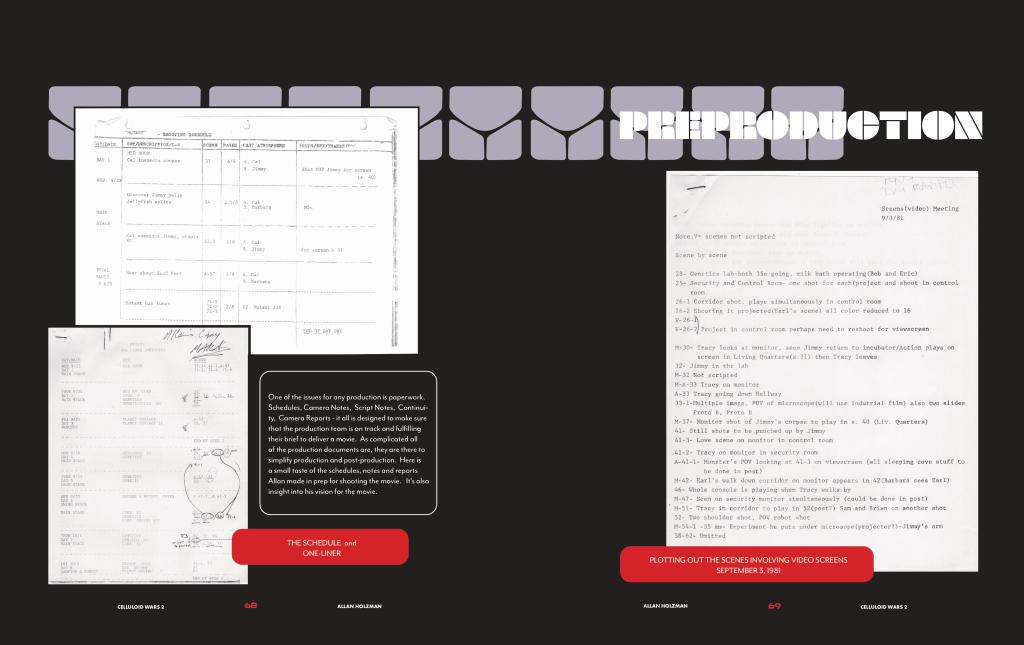
The book then goes, step by gloriously illustrated step, through the process of achieving that goal: script problems, monster development, casting, recasting, responding to Corman’s barked orders – which alternate with often kind, reasonable, and knowledgeable support – building sets, designing sound, directing actors, falling behind schedule, showing a cut to preview audiences and dealing with Corman’s demands that the film be recut.
The Orgasm Theory
Trying to solve the movie structurally as he developed the script, based on an original story by pre-Chopping Mall Jim Wynorski and R. J. Robertson, Holzman doesn’t fall back on the played-out three-act structure. He creates what he calls a roller-coaster chart of the scares. He organizes the movie according to Wilhelm Reich’s theory of sexual excitation, something I think more filmmakers should do: foreplay, voluntary excitation, involuntary excitation, climax, orgasm.
The movie’s mixture of sex and horror consequently wasn’t just something Corman imposed for exploitation purposes. Holzman was thinking of erotic rhythm as formal structure.
JAMES KENNEY: Your five-stage orgasm chart is fascinating because you’re using sexual excitation as actual dramatic structure. Were you consciously trying to connect the movie’s sexuality and horror, rather than simply fulfilling the exploitation requirements of a Corman picture? Have you used that structure since?
ALLAN HOLZMAN: My artistic connection to film and theater as a director is based entirely on living within that structure. It’s a natural guideline for me to define where in the story I am and always provides natural, heartfelt rhythms that are varied and have a build, also with an emotional resonance. It was the primary gift from my professor at Bennington. His approach to theater and filmmaking always focused on subtext. My imagination is deeply rooted in emotion, which can easily be placed in a sexual context or sexual rhythm. I often used it in an action scene while editing a scene with no form at all. I could give it a rhythm by following the pace of this five-act structure.
Freedom on a Low Budget
JAMES KENNEY: One paradox in the book is that Corman’s cheapness constantly threatens your ideas, yet it also forces everyone to invent. Do you think Forbidden World would actually be a better movie if somebody had simply handed you three million dollars?
ALLAN HOLZMAN: It probably would have been the same movie, only the monster probably could have moved better. And the crew could have been paid better. But I feel the movie’s very nature is tied to low budget, so it’s hard to imagine it with more money. We probably could have breathed easier on the set with an extra two weeks. But with space and science fiction, the fun and sheer joy of participation in that unique world gives so much opportunity to express things that you would never be asked to express in any other context. In a way, you’re always living in a fantasy when you’re making a low-budget movie, and especially science fiction.
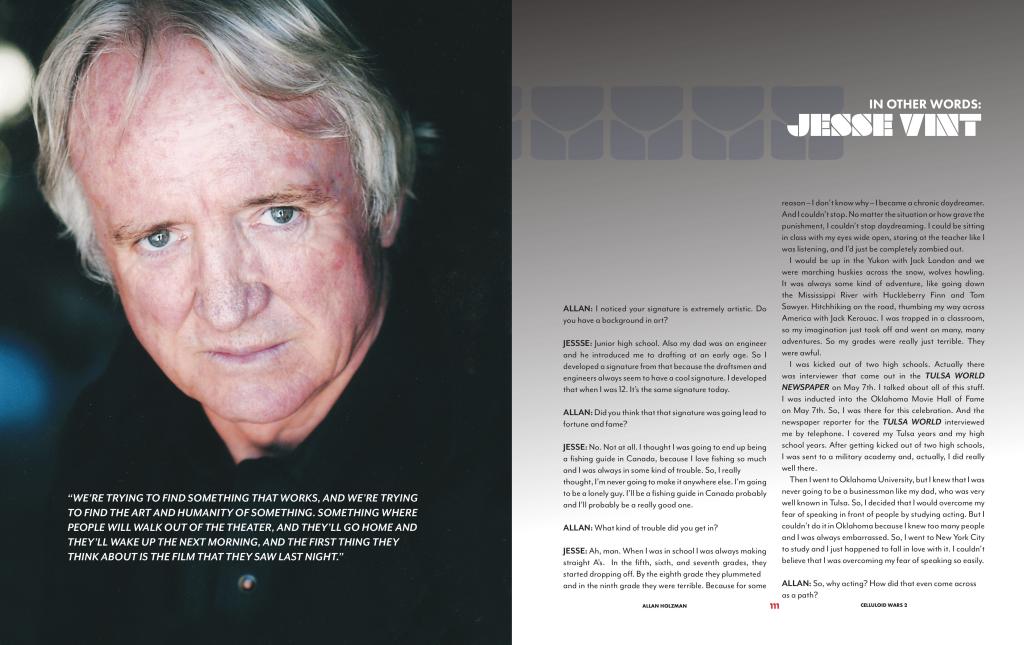
JAMES KENNEY: The diary can be brutally candid about actors – including Jesse Vint – but the later interview with Jesse is affectionate. Was it strange confronting your 1981 reactions to people you now remember very differently?
ALLAN HOLZMAN: It was very strange. He never liked me from the outset. I had no macho sensibilities and he led with macho and seemed not to like any of my ideas. I felt he lacked the desire to explore and had an image of himself that exceeded any involvement on my part. But he was assigned to me and I had to make the most of it or at least try. In great part, I rebelled against him, siding with the women and Cal. I felt I could influence those roles to be the best they could be.
JAMES KENNEY: Jesse brought you stories about how Roman Polanski directed actors (from his experience shooting Chinatown), and you consciously incorporated some of that into your own method. How much of directing your first film was simply collecting lessons from every filmmaker and actor you’d encountered and discovering which ones worked for you?
ALLAN HOLZMAN: I wish I had more of those opportunities. As a stutterer, there are very few apprenticeships available to you. And you don’t want them anyway, since you have to talk with a teacher if it’s one on one. But I was mostly concerned with getting great shots, which required a tremendous amount of planning and management on set. I knew that I could get a production shot first thing, perhaps before lunch and right after lunch. But it was always a scramble and reshuffling of shots to make the day. However, making the day meant freedom on the set. Roger would be happy as long as I kept on schedule and budget. If Roger was happy, then I was free. I took Roger’s advice to announce the next shot and where the camera was going immediately after the accepted take. From my experience directing theater I knew enough approaches to dealing with acting that I could pick and choose my methods according to the actor’s needs.
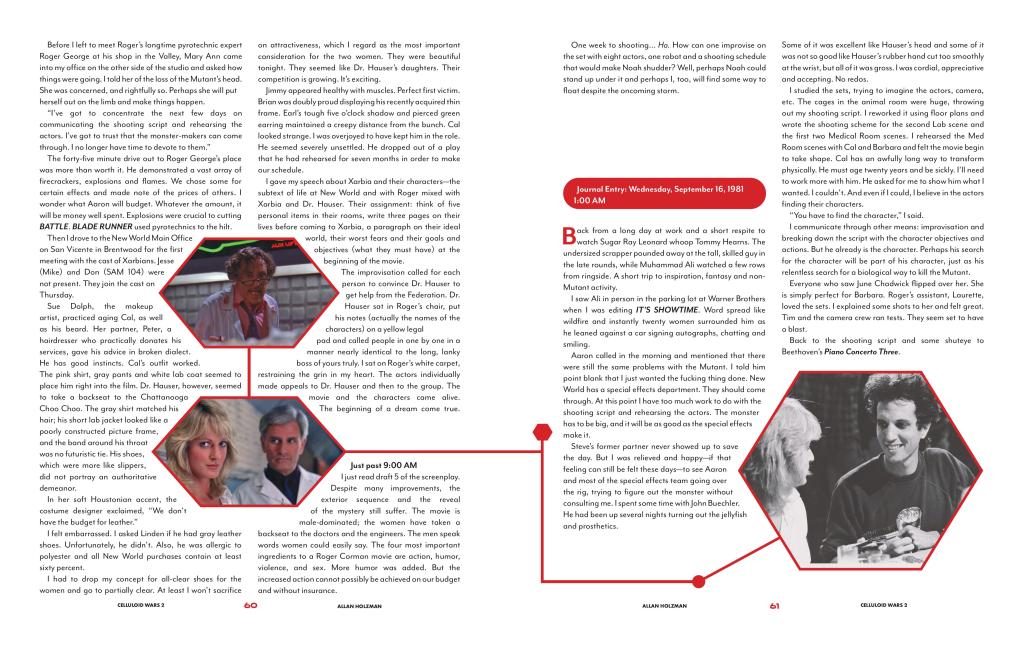
JAMES KENNEY: Some of the diary’s writing about sex, actresses and nudity is extremely frank and very much of 1981. When you read those passages today – especially the disagreement with June Chadwick – do you see those situations differently?
ALLAN HOLZMAN: I just enjoy seeing how everything came out that still is beautiful to watch. I think the best was when they were walking in their skimpy terrycloth robes and bare feet, trying to get around the glob transformations of the ever-expanding mucous membranes.
But this led to deep moments of fear. Both actresses were extremely dedicated to making the most of their roles, and I tried to support them and communicate my vision. They enjoyed that and gave me their fullest. June had her ways to block my wishes at times, and I had to let her win those battles so I could win the big one with the overhead shot.
The Battle Over the Movie
JAMES KENNEY: At that first sneak preview you thought the laughter meant the movie was working. Roger thought it meant the movie was dying. Who do you think was right?
ALLAN HOLZMAN: I was so right it still hurts, though I’m completely happy with how my life and career have evolved. No regrets at all. I’m still making movies, and that’s amazing. But when the Hollywood audience gave a standing ovation on the opening night of Firecracker after the chase and fight scene, I felt that I was on a wavelength, communicating to an audience that it was okay to interact. To talk to the screen. To cheer and yell and to get excited in the theater. I saw that happen during the sneak preview of Forbidden World. But I could not have gotten there without Roger. It was his fantasy, his obsession with ripping off and with sex and violence. I was making it a playground. He came in and sent us back to homeroom.
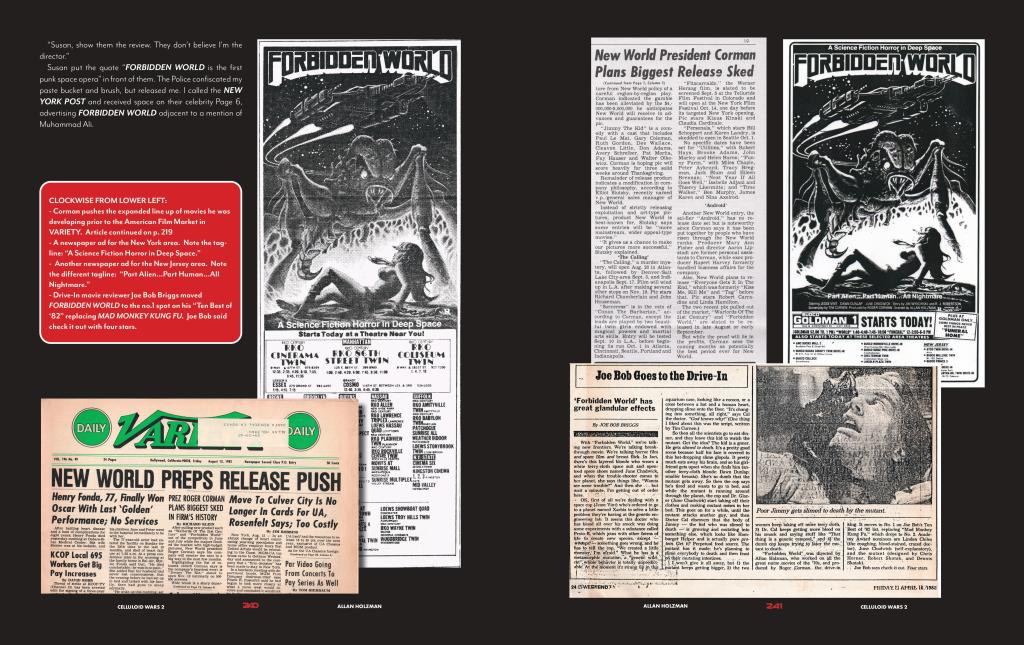
For those interested, both Holzman’s original cut (titled Mutant) and the release version are available on the Shout! Factory Blu-ray. Holzman basically stole the only print of his cut from Corman and wouldn’t give it back. Corman threatened to call the cops on him, but because deep down Corman really loved filmmakers, one suspects, he reached a compromise with Holzman that allowed the print to survive. Corman comes off as occasionally the enemy of Holzman’s film, occasionally the person saving it, and sometimes both at once.
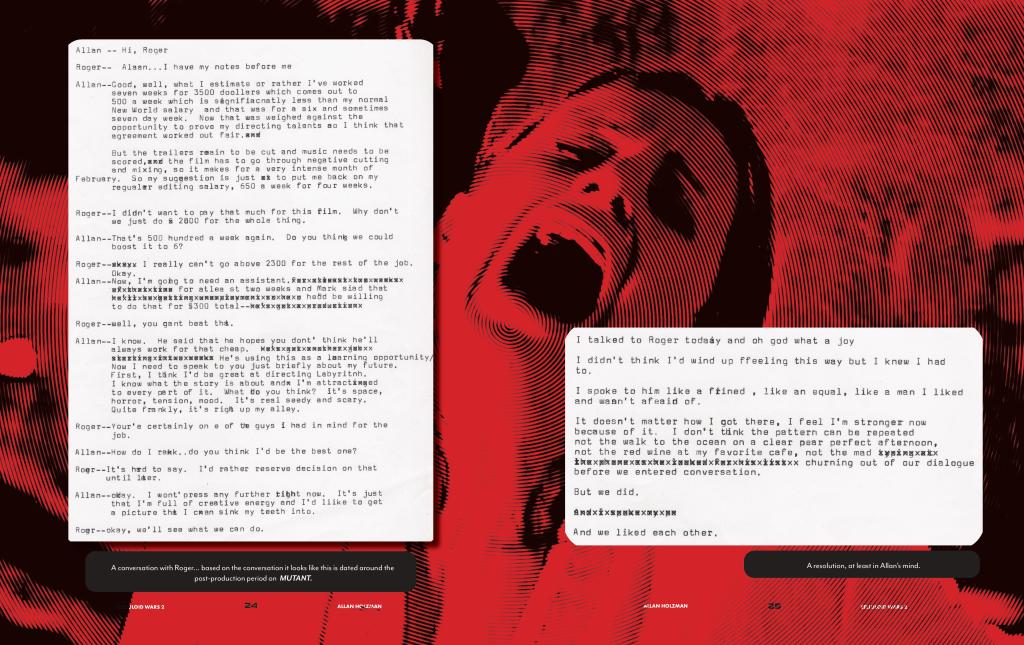
JAMES KENNEY: You physically took the Mutant answer print because you feared Roger would destroy your version. You ultimately reached a compromise that saved your cut. Did Roger forgive you, or was your relationship over, more or less, after this?
ALLAN HOLZMAN: Our relationship was completely over. I tried to deceive him and got caught. I was angry. I’m not sure how he really felt. But he was definitely upset by my attempt to be silly, to create laughter in a thematic way in the original cut that undercut the serious side of the film. But he did ask me three times to direct his next movie.
JAMES KENNEY: The book presents Corman as simultaneously mentor, antagonist, financier, teacher and obstacle. Which Roger Corman do you remember most strongly now?
ALLAN HOLZMAN: Teacher. He was definitely the boss. I wanted to please him. But I felt that part of pleasing him was having a passion for filmmaking, which he had in his directing career. A Bucket of Blood is one of my favorite movies, and I loved the Poe films.
Still Living It
The diary repeatedly frets over whether the movie will work. That uncertainty is part of what makes Celluloid Wars 2 so alive: the young filmmaker trapped inside its pages cannot know that Forbidden World will survive for more than forty years, that both versions of it will remain available, or that readers will one day be able to inhabit his fear, exhilaration and creative freedom almost hour by hour.
JAMES KENNEY: The diary repeatedly asks variations on “Will this movie work?” Now that Forbidden World has survived for more than forty years, what do you think the young Allan Holzman would make of the fact that we’re still talking about it?
ALLAN HOLZMAN: He would be overjoyed, as I am now. I don’t really feel that I have matured enough to be out of touch with that version of me. Recently I completed my autobiographical documentary that tells the story, so in a way I’m still privileged to be living it. This summer at the Lighthouse International Film Festival, where my autobiographical documentary Celluloid W-W-Wars had its world premiere, the person who moderated the discussion after the film told me how he discovered Forbidden World when he was 9 and he watched it over and over and it’s had an enormous influence on him. Now that’s show biz!
Holzman is passionate. The film is wild. The book is fascinating. Check it out.

-30-


Leave a Reply