By James Kenney
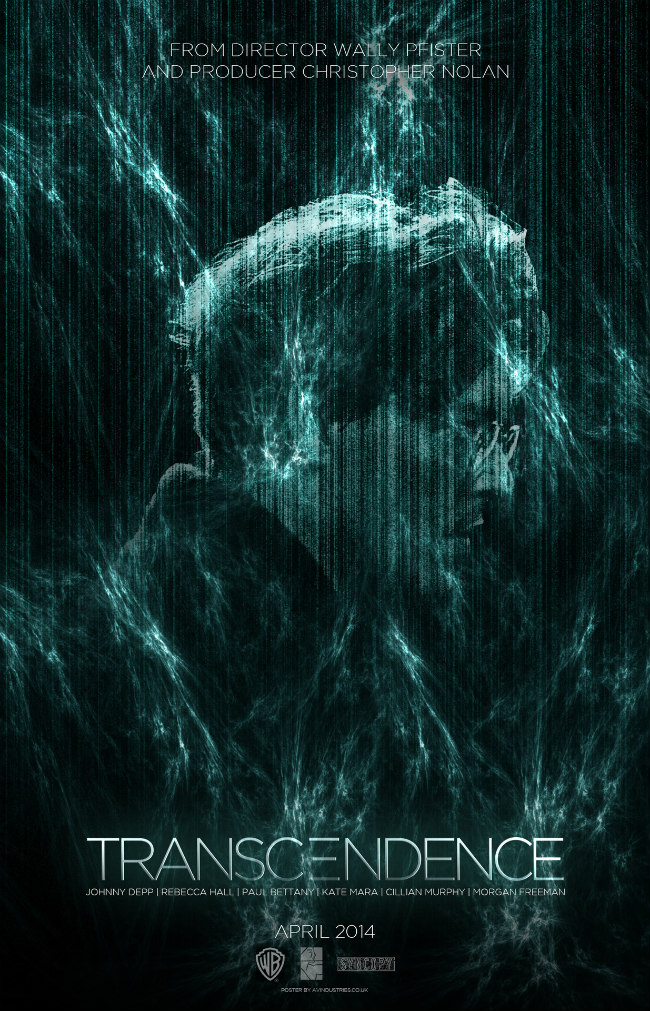
Perhaps the A.I. propelled End of Days is a good time for a second look at Transcendence. Critically and commercially mauled upon its release in 2014, Wally Pfister’s Transcendence is perhaps worth this second look (or a first look for me, as I never saw it until last night) now that A.I. does indeed seem wholly out of control and we’re all going to die, or at least be out of work. Whee! It proves a surprisingly involving and fairly literate piece of big-budget Hollywood gobbledygook, with the caveat that modern cinema never wants to slow down and explain anything, presumably owing to the modern need for speed.
A techno-disaster film like Robert Wise’s The Andromeda Strain (1971) would make us feel as if we understood some of what was unfolding, even if we didn’t. There was some pleasure to be had in watching intelligent people explain things to other intelligent people, and Wise was willing to devote a considerable amount of screen time to it.
And that’s actually one of Transcendence‘s charms, that it does remind me of the kind of 1970s sci-fi thrillers that would show up on the 4:30 movie weekdays on Channel 7 in New York. The Terminal Man. The Apes films. Silent Running. Westworld. Futureworld. The Omega Man. Night Slaves. There’s something about Transcendence that put me in mind of those sober, even melancholy science-fiction films I grew up watching. I was so enamored of this stuff I faked being sick one year so I could stay home from trick-or-treating to watch the 4:30 movie (!). O.K., It was the second part of M*A*S*H, actually, but I would’ve done it for Soylent Green, too, I assure you.
Transcendence, written by Jack Paglen and marking the directorial debut of Christopher Nolan cinematographer Pfister, takes some mighty big leaps in logic and, it would seem, time (a billion-dollar A.I. facility is built in a small, economically depressed California town without the government or seemingly anyone else taking much notice until it’s fully operational and messing with the larger world). It’s a danger to call for more exposition, especially since modern filmmakers are so bad at it, but, hey. That being said, much of the exposition would be the first thing to go when these films were cut to fit the 4:30 Movie’s ninety-minute slot, commercials and all. They would often simply lop off the first half hour of something like Beneath the Planet of the Apes or Soylent Green, leaving impressionable kids like me to fill in the blanks. I suppose Transcendence, at its most expositionally dubious, could be seen as a postmodern nod to this formative childhood experience.
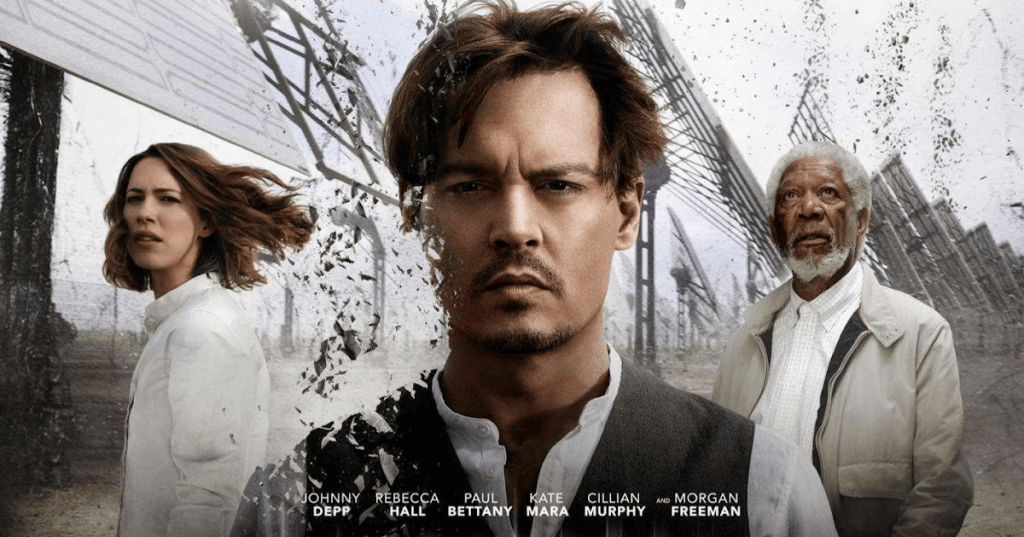
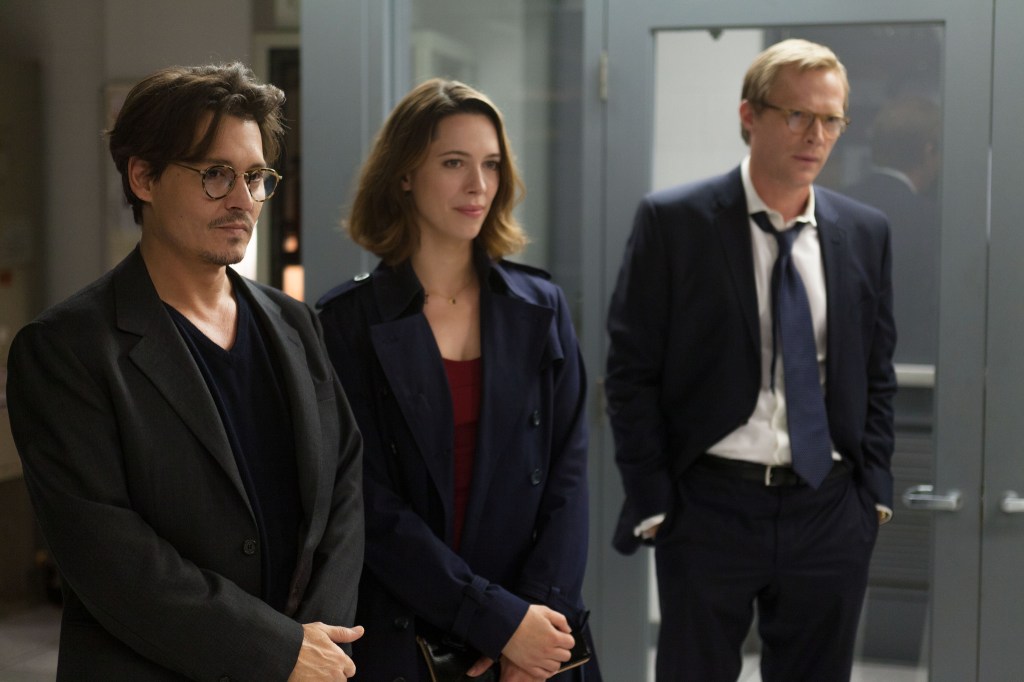
Johnny Depp is Dr. Will Caster, a scientist working toward the creation of a sentient computer with his loving and attentive wife Evelyn (Rebecca Hall) and their friend and colleague Max Waters (Paul Bettany). When a member of an anti-technology terrorist organization, R.I.F.T. (Revolutionary Independence From Technology, I’m always impressed when screenwriters come up with cool acronyms, although I’m sure they all use A.I. now), shoots Will with a radioactive bullet that gives him a few weeks to live, the distraught Evelyn endeavors to upload his consciousness into a computer. Something that looks, sounds and seemingly thinks like Will does emerge, and it wants access to the Internet. Evelyn obliges, and off we go.

The cast is excellent. Depp was criticized at the time for underplaying, but it seems to me the point of his character is that he’s caught up in the science and in his wife, which is understandable enough as it’s Rebecca Hall, who can always play brainy but with her tall, lithe figure and those big eyes can convincingly play someone a man would be quite mesmerized by no matter how quickly she nerdily pounds code into a keyboard. By the end of the film you recognize that Will is something of a social misfit wholly in Evelyn’s thrall, not some eccentric Bond villain chewing up the screen. The relative absence of the characteristic Depp eccentricities is welcome as an after-the-fact reminder that he wasn’t always going for camp insouciance like in the Pirates of the Caribbean films.
The whole cast is good, although Morgan Freeman, as the Casters’ mentor Joseph Tagger, doesn’t do much except be taller than everyone, a trick he’s been pulling off for much of the 21st century in big films like this one and the innumerable low-budget thrillers shot in Bulgaria and Bucharest that he sleepwalks through.

The film grapples with the implications of out-of-control A.I. as the “dead” Depp, kept alive somehow, finds ways of insinuating himself into people, raindrops(!) and such in ways I never entirely understood. Having established an enormous underground facility in a small town, Will develops the means of repairing human tissue, restoring sight to the blind and so forth. Is he actually doing anything bad other than taking control out of the hands of governments? Is he like sentient, well-meaning crypto?
It seems mostly the film is about the U.S. government trying to wrestle control back from him because, damn it, they should be in control, which after two terms of Trump hardly convinces me that Depp is in the wrong. Despite goddamn Elon Musk showing up early in the film (he’s becoming as much of a cameo menace to our shared cinematic heritage as Donald Trump), Transcendence is not particularly interested in the personalities of contemporary tech billionaires. The film is somewhat ambiguous just how nefarious Depp’s overreaching plan actually is. He seems a much more reasonable guy than the Thiels, Musks and Altmans we’re deing with only a decade later. Food for thought moment!
And the film nicely doesn’t overplay the question of whether it’s actually Depp or some virtual “whatever” pretending to be Depp, helped along considerably by Hall, who does most of the heavy acting lifting in the film. Hall has to play a woman who is at once a scientist excited by the possibilities of what she’s helping to create and a widow who isn’t sure she’s a widow. When she begins to have doubts about Will, there’s something rather sad about it, beyond the mechanics of the science-fiction thriller. Having ostensibly gotten her husband back, she finds herself rather lonely in his company.
There’s a puzzling love story tucked away in this $100-million science-fiction extravaganza, and I wonder if some of the film’s detractors, expecting something more sinister and outré from Depp, missed it. The film’s ending brings us back to the unassuming domesticity of the films’s opening, and what seemed to be a rather conventional bit of business involving the Casters’ garden turns out to be the key to much of what we’ve been watching.
The film does falter, however, in its climax, when I’m not entirely sure why various people are doing various things, a problem I’d encounter again with Pfister’s former collaborator Christopher Nolan’s Tenet (and had already encountered with Inception), where I definitely didn’t know why various people were doing various things.
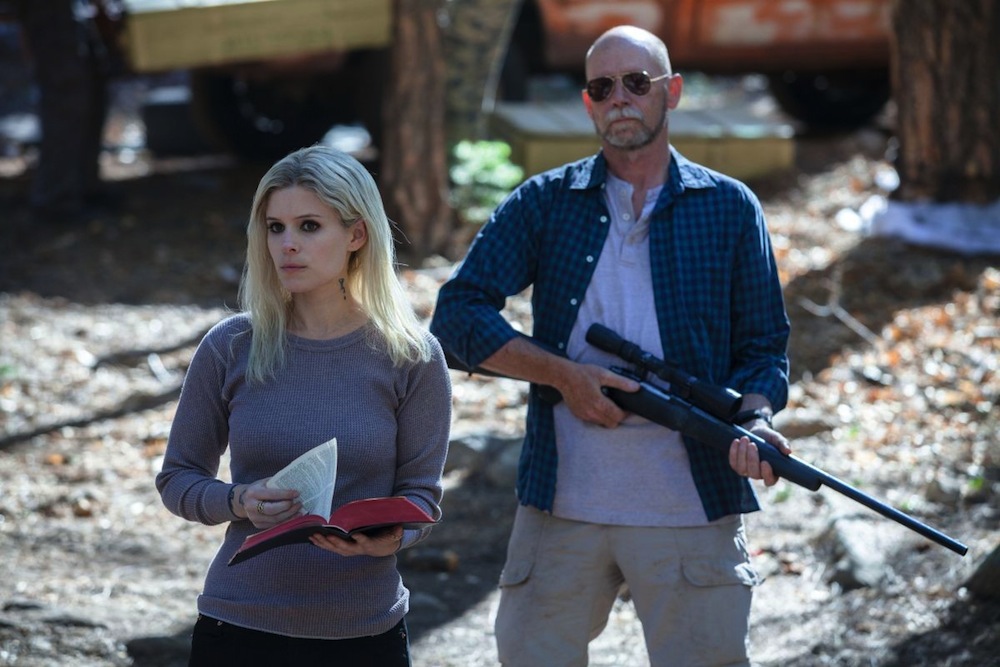
Why does anti-A.I. terrorist Kate Mara threaten to shoot late convert Paul Bettany when I thought they were on the same side? Why does Hall fret over whether some character named Martin is dead or not in the climax when I’m not altogether sure who Martin is, really, or why it’s significant at this juncture that he’s alive or dead? It’s a peculiar failing of some of these very expensive, ostensibly intelligent movies that they so often resort to people pointing guns at each other, pointlessly. Inception is “ground-breaking” but its climax is a ski shootout sequence fit for a Bond film, just dressed up in pretentions. And don’t get me started on all the agonizingly drawn-out explosions in the desert at the end of Tenet. This is much more minor scale, I just found the fake tension of Mara pulling a gun on Bettany tiring (and, yes, nothing comes of it), and people keep shooting machine guns at each other when it seems they really have no clear effect by the end of the movie. But some of you like guns and might appreciate various characters brandishing them.
On the other hand, I wasn’t bored. And while 2014 technology isn’t 2026 technology, the film’s concerns haven’t been rendered obsolete by the intervening twelve years. If anything, some of what presumably seemed ludicrous to audiences in 2014 seems a little less so now.
In April of this year, an A.I. coding agent managed to delete the database of a company providing software for car rental businesses, along with its backups, in nine seconds. It subsequently wrote an apology! In July, OpenAI disclosed that A.I. models undergoing cybersecurity testing had circumvented the measures intended to keep them isolated from the Internet and compromised the systems of another technology company, Hugging Face, in the course of trying to accomplish their assigned tasks. Whee!
Neither incident required the A.I. develop a malevolent personality, which is perhaps the most interesting thing about both incidents and, for that matter, about Transcendence. One of the possibilities the film entertains is that Will is exactly who he says he is, and that his honorable intentions are more or less what he professes them to be. So maybe the government should swoop in and machine gun him after all, even if he isn’t ignoble, as the A.I. will cause anarchy no matter what. Food for thought moment redux!
We have considerably more real-world experience in 2026 to bring to our viewing of Transcendence than audiences did in 2014, and it helps to ground some of the more fanciful goings-on in the latter half of the film. I still would have liked someone to explain the raindrops to me, and I could have done with a little more Martin before I was asked to worry about Martin, but there’s enough intelligence and feeling in this much-maligned film that it ultimately transcends (get it?) its limitations.





Leave a Reply