By James Kenney
Why David Mamet is Still Worth Reading
When artists talk about mountains of unreleased work or writers lament the masterpieces that never got produced, it’s hard not to occasionally suspect a bit of self-mythologizing — as though being merely great isn’t enough, and they also need us to believe they were endlessly prolific in their greatness. But then someone like Bruce Springsteen spends decades hinting at legendary vault recordings, abandoned albums, marathon sessions, and impossible-to-finish songs, only to eventually release the material and prove that, hell, he hadn’t been exaggerating at all.
Mamet is another one.
David Mamet has often spoken of the mountains of unproduced screenplays he’s accumulated over the years, as if his prolific published and produced work weren’t already impressive enough: more than forty plays, over twenty-five screenplays and teleplays, five novels, and nearly twenty nonfiction books. But he, too, apparently isn’t bluffing when he talks about the quantity — and quality — of the unproduced work he’s amassed.
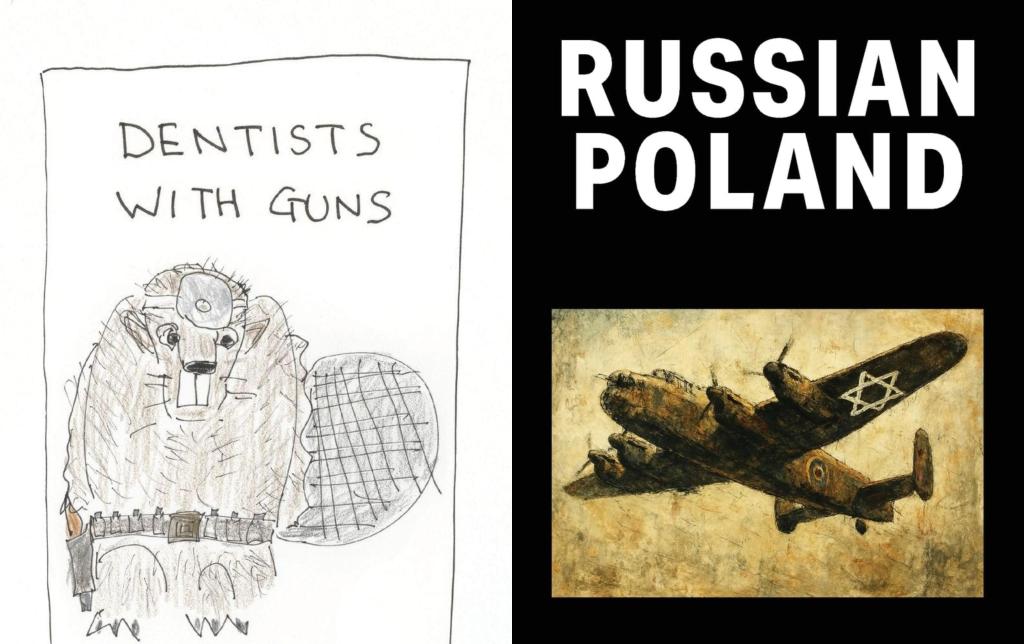
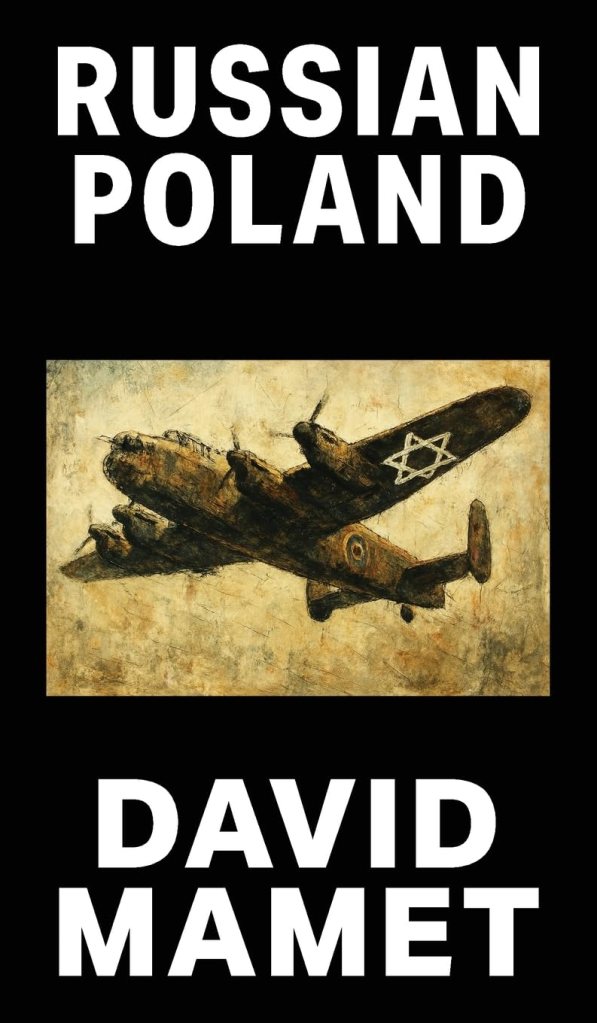
Sticking Place Books has an ongoing “Lost Screenplays” series devoted to sharing unproduced works by important authors with the public. I myself have spearheaded the publication of works by Brian De Palma, Larry Cohen, Jim McBride, Alex Cox, and Rudy Wurlitzer, with publications by Steven E. de Souza and Lizzie Borden coming shortly. Sticking Place has also published fascinating unproduced work by Werner Herzog, Bruce Joel Rubin, Preston Sturges, Charlie Chaplin, Eve Babitz & Michael Elias and, most recently, Mamet’s Dentists With Guns, which he intended to direct after his 2001 caper film Heist, with Steve Martin (from Mamet’s The Spanish Prisoner) and Dustin Hoffman (from Mamet’s Wag the Dog) attached to star. It never happened, for, one imagines, one of the usual combinations of financing, scheduling, and industry hesitation, but Sticking Place has unearthed it, along with Mamet’s singular Russian Poland, released last year.
I have no stake in, and did no work on, these particular Mamet releases, but as you might suspect, I’m fascinated by projects like these: blueprints for films never made, but also, in some ways, pristine — the author’s vision before being diluted by budgetary compromise, studio dictates, or miscast performers.
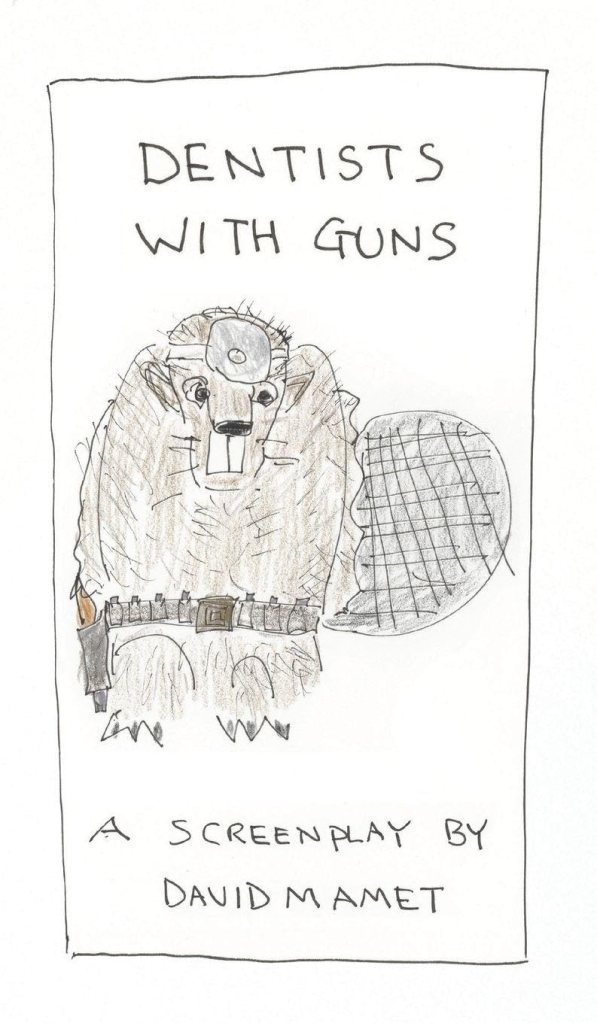
Dentists With Guns fits comfortably into Mamet’s oeuvre (I’m fairly certain I’m using that word correctly), as it focuses on his long fascination with ritualized male environments. On the surface, Dentists with Guns is about a group of affluent dentists attending a pharmaceutical-company-sponsored cowboy retreat in a fake Western town, but like most Mamet, it quickly reveals itself to be about performance, hierarchy, ritual humiliation, and men testing one another through language.
The fake Western town “Zinctown” is a classic Mamet environment, governed by invisible power structures, and while, on the surface, the film is broader and less grounded than most Mamet work, it feels spiritually connected to classics such as State and Main, with its manufactured Americana; Wag the Dog, with its fabricated reality for political (or, in this case, corporate) ends; the focus on male fraternity seen in Speed-the-Plow and Glengarry Glen Ross; and the endless systems of deception that harken back to House of Games and The Spanish Prisoner.
For those who love that classic Mamet wordplay-as-swordplay dialogue, the characters in Dentists constantly interrupt, posture, assert status, test one another, and conceal their insecurities beneath rhythmic banter. The script argues that American masculinity is theater staged by corporations, as the dentists are not “cowboys”; they are affluent professionals playacting at frontier masculinity (a theme also explored in Mamet’s screenplay for The Edge, with city slickers Anthony Hopkins and Alec Baldwin abandoned after a plane crash and .forced to face down nature itself, embodied by a rather ferocious bear).
Dentists can be read as revealing some of Mamet’s “creeping conservatism” in its distrust of institutions, mockery of elite liberal professionalism, and celebration of toughness, competence, and realism, with protagonist Scott — awkward, naïve, and morally hesitant — mocked both by the environment around him and by antagonist Brad, who manipulates all comers through faux cowboy mythology and pseudo-sincerity. Nevertheless, the film skewers corporate America, presents masculine mythology as fundamentally absurd (very different from works such as Spartan), and can be read, whether Mamet likes it or not (I suspect he does, he’s nothing if not a contrary son-of-a-gun), as deeply suspicious of capitalism’s colonization of identity, with corporations manufacturing fantasy and masculinity itself becoming a form of branding.
Dentists With Guns is, like the best Mamet, simultaneously cynical and sentimental, anti-corporate and anti-liberal, mocking of masculinity and yet fascinated by it. And it’s awfully funny, adding to his underrated collection of outright comedy screenplays, including Things Change, the underrated We’re No Angels, State and Main, and Wag the Dog. It’s very much worth your acquaintance.
If Dentists With Guns is Mamet’s grotesque corporate nightmare-comedy, Russian Poland is its opposite pole: mystical, mournful, folkloric, tender even. Russian Poland interweaves the story of Jewish pilots smuggling a Holocaust survivor to Palestine in a stolen military plane in 1948 with mystical Hasidic fables from Eastern Europe about faith, misunderstanding, and sacrifice. The screenplay touches upon questions Mamet first explored onscreen in Homicide, his second film as a director, in which a police officer must decide whether his ultimate loyalty lies with the fraternity of police to which he belongs or with his Jewish faith. This script again asks: What constitutes faith? What makes authority legitimate? What is obedience? Can action redeem corruption? As such, it would make a fascinating double feature with Homicide, though Russian Poland is far less of a genre exercise. While framed by the theft of the military airplane, much of the script is devoted to nested fables and performative storytelling unfolding within the dangerous aviation narrative.
The sceenplay also shares the reverence for tradition that can be seen, in its own way, in Glengarry Glen Ross, with its land salesmen bemoaning the lost better days of their racket. Just as Roma and Levine celebrate the old ways of hustling potential marks and clients, Russian Poland strongly affirms inherited ritual and patriarchal authority structures (in Glen Ross, the wildly successful Roma still holds the struggling Levine in esteem because he represents an older school of salesman, almost a father figure). Russian Poland is obviously after something different in its argument for faith over secular rationalism, but its belief in historical memory and inherited wisdom is not entirely unlike what we see in Glengarry. The script clearly aligns with Mamet’s oft-stated belief that Israel was an emergency act of survival after catastrophe — not merely a subject for geopolitical debate, but, in his eyes, a mythic civilizational refuge. The result feels like Mamet attempting to write a sacred text of sorts: a myth of Jewish survival, ritual continuity, sacrifice, and historical rebirth.
Whatever one makes of David Mamet in 2026 — politically, culturally, or personally — these scripts are reminders that he remains one of the most singular American writers of the last fifty years. These “lost” scripts don’t merely preserve films that never got made; they preserve a major American talent still wrestling with his major themes in ways that remain provocative, funny, unsettling. Even unproduced, Mamet remains difficult to ignore.
-30-



Leave a Reply