By James Kenney
Richard Shepard is my kind of director. He makes movies. He doesn’t make events, he hasn’t made “tentpoles” or sequels (though would be up for the challenge), but he’s a guy who would’ve found a way to make it work in any system. Think Phil Karlson, think John Flynn, think Andre De Toth, think John Hough and Roy Ward Baker from across the pond, and at Shepard’s best, with his ability to mash up genre with offbeat character moments, think Jonathan Demme, and you have an idea of who Richard Shepard is, even if his is not a household name. Shepard has a “sympathetic imagination,” to borrow a phrase from Pauline Kael describing Demme, showing as much empathy for the bad as the good in his offbeat genre exercises, and an ability to stretch so that he doesn’t only generate a superior comic thriller like THE MATADOR, but can direct an UGLY BETTY pilot that ensures a network order for an additional thirteen episodes.
Chances are he’s directed something you’ve dug throughout the years, maybe multiple somethings. Like the aforementioned 2005’s THE MATADOR, which allowed Pierce Brosnan to remind the world he could really act after a decade of Bond. Like 2007s THE HUNTING PARTY, a pitch-black comedy about journalists and war crimes with Richard Gere and Terrence Howard. Like 1995’s MERCY, a low-budget thriller with a young Sam Rockwell and John Rubenstein that had a healthy run on cable in the 1990s. Shepard has helmed pilots for shows such as UGLY BETTY, multiple episodes of your favorite television shows like HANDMAID’S TALE and GIRLS, and the 30 ROCK episode where Gladys Knight shows up to sing “Midnight Train to Georgia.” That John Cazale documentary on cable you loved? Shepard. His most recent documentary about his obsessive cinemagoing in his formative years, made up entirely of clips from over 200 films, including his own early 8mm efforts, FILM GEEK, opened theatrically this year at the Film Forum in Manhattan and throughout the country.
This year Shepard also theatrically premiered his new director’s cut of 1991’s THE LINGUINI INCIDENT, a caper comedy he shot (at age 25) at the height of the 90s “indie craze” following SEX, LIES AND VIDEOTAPE’s box-office and critical surprise success — back then, if you had talent, ambition and luck you could mount and release an original project outside the Hollywood system with the hopes of gaining traction and attention, although you may have to work with some dubious people to get it financed. But not only did Shepard have all three (plus the dubious financing), he somehow managed to gather David Bowie (in a rare romantic comedy lead), Rosanna Arquette, STRANGER THAN PARADISE‘s Eszter Balint, Marlee Matlin, Buck Henry, Andre Gregory and Viveca Lindfors for his debut effort. Nevertheless, he was never happy with the original version and recently managed to track down his lost film and recut it despite not having access to any outtakes or alternate takes, using his thirty-plus years of film experience to recraft this imperfect but beguiling relic from a lost era (and boy, we didn’t know how good we had it then) into a stronger work.
THE LINGUINI INCIDENT arrives on a stacked Blu-ray from MVD next week (streaming as well), and I thank Richard for spending time with me recounting the highs and lows of a fascinating career with good humor and energy.
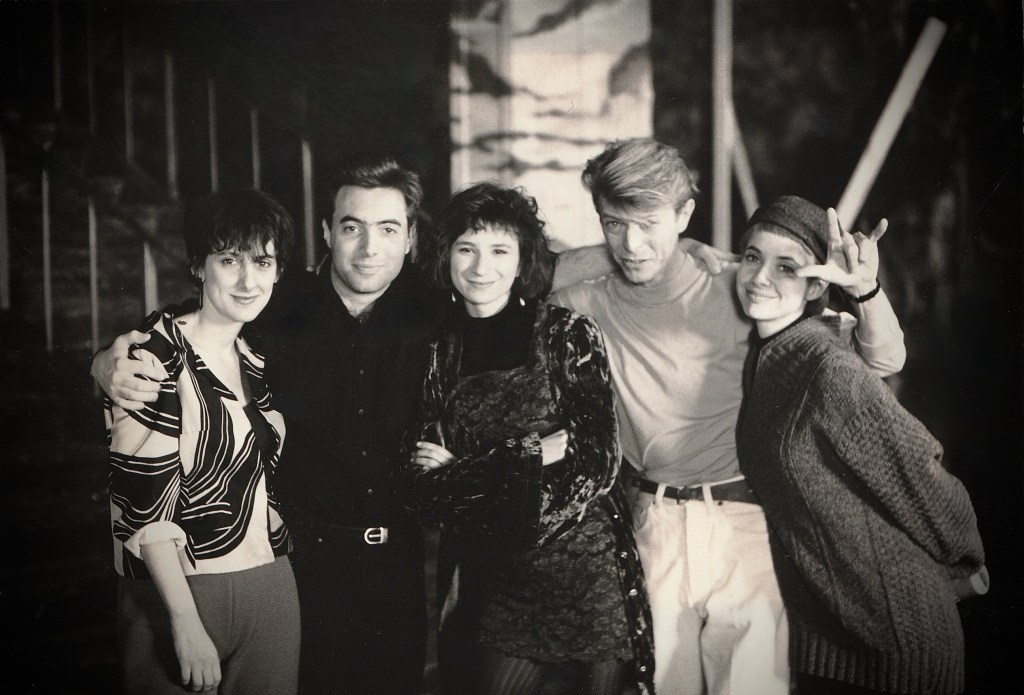
Co-writer Tamar Brott, Shepard, Eszter Balint, David Bowie and Rosanna Arquette on the set of THE LINGUINI INCIDENT (courtesy of Richard Shepard)
Directing a film with David Bowie and Rosanna Arquette is quite an achievement at age 25. Can you talk a little about how you got into directing and how this project came into existence?
After I realized that I was never going to be the third baseman for the New York Mets, at around age 12, I shifted my attention to filmmaking. Super 8 was my life, and I begged, borrowed and stole to get enough money for a new roll of super 8 film for whatever epic I was dreaming up in my head.
I went to NYU to study film, and moved to LA the day I didn’t graduate in 1987. One of my friends at film school was Roman Coppola and when school was over, Roman was working for Zoetrope producing a series of ultra-low budget movies. One of the films, “Smash, Crash and Burn” a heavy metal rock n roll comedy was in trouble and there was decision to replace all the band’s voices (it had been a real band playing the leads) with actors’ voices and I was hired not only to supervise the 2000 limes of ADR recording but also to write off camera jokes that could enliven the film. Tamar Brott, who was an Oakland writer, was also hired by Roman’s dad to do the same thing. So we were thrown together on this crazy movie, spent weeks casting and recording and rewriting and eventually fell in love (we went out for 6 years). Early on we realized we liked writing together, and we would go to Reno and eat at all you can eat buffets and see old variety acts like Dean Martin and Phyllis Diller and write. And that’s where THE LINGUINI INCIDENT was born.
Often directors make indie films with relatively low-profile casts which then allow them some prep for when they work with major stars/artists (Kevin Smith doing CLERKS before directing Salma Hayek and Alan Rickman in DOGMA, Hal Hartley working his way up to Isabelle Huppert in AMATEUR). But you found yourself directing major stars in David Bowie, Arquette, Buck Henry, etc. in LINGUINI. Did you find they wanted to take direction from a rather young first-time director? Were they suspicious or open to your ideas in general? Did it feel natural telling them “faster!” or whatever, or daunting?
I had the confidence and cockiness (and ignorance) of youth, so I wasn’t afraid. We knew so little that we just went after whatever actor we wanted, not knowing that it was impossible or unlikely that they would do a low budget film with a first-time director for no money. We went out to Bowie and Mick Jagger to play the supporting roles of restaurant owners that Andre Gregory and Buck Henry ended up playing. That’s how insane and naive we were. But strangely that’s how Bowie read the script and he came back to us asking to play not a supporting character but the lead! Marlee Matlin approached us and asked us to be in it after we cast Bowie and Rosanna and we rewrote a part so she could be in it. We were blessed in the casting part of the process. As to being on set with these experienced actors, I think a number of them like Bowie just trusted me (it always helps to be the writer as well, if I hadn’t co-written it I don’t think they’d have had the same respect). Rosanna was looking for a stronger hand I think, so it was a bit tricky with her, as I was just getting my directing sea legs. Marlee, Andre Gregory, and Eszter were great.
Buck Henry was a bit of a prick. Derided the whole production. But that was the least stressful thing that was happening; checks were bouncing, our producer disappeared for days at a time, I had to fire Shelley Winters myself (!) and then the producer took the film away from me. It started out as a dream but ended up a nightmare.

Adrian Brody with Shepard on the set of OXYGEN (Courtesy of Richard Shepard)
I actually know you best as a twisted-genre filmmaker, often making darkly comic-ironic thrillers. The first film of yours I actually saw was the unjustly obscure OXYGEN from 1999, starring a young Adrien Brody alongside Maura Tierney. Shot on an extremely low budget, the film nevertheless utilizes ambitious New York City locations, including a car chase around Grand Central Station and Park Avenue (!). How did you get the idea for that, and can you talk a little about the incredible cast you gathered for it?
I couldn’t get arrested after LINGUINI stink bombed at the box office (I actually got turned down to direct soft core porn, it was that bleak). I started spending an unfortunate amount of time obsessing about how the LINGUINI producer had ruined my life and how I should kill him. This is true. It was an unhealthy period of my life. I gained weight, drank excessively. I was truly deeply depressed. Finally, Tamar told me that if I killed Arnold I would be caught and go to jail and I wouldn’t do well in jail, and that I should instead get very successful and that would be the best revenge. And with that sage advice, she snapped me out of my two-year depression.
I wrote a very gritty, very dark kidnapping thriller called MERCY and tried to get it made by the studios, but eventually decided to make it myself. I raised $52,000 bucks in $2,000 dollar increments and shot it on super 16 in 18 days in NYC in 1995. It was the greatest experience if my life. I was back directing and. I had made it happen. I had willed it to existence. I got John Rubenstein and a very young Sam Rockwell to be in it, and I finally had a movie I was proud of. We sold it to HBO and did some foreign sales and was able to pay my crew their deferments and make a little money and go to film festivals and get some nice reviews and basically get my mojo back.
I then wrote OXYGEN. I was obsessed with THE FRENCH CONNECTION; I loved a gritty 1970’s NYC thriller and I wanted to do a car chase up Park Avenue. I wrote the script very fast and raised a million bucks from the same foreign sales company that had put MERCY out, and from the “air freshener king” of Long Island. I had gone to school with Maura Tierney and she was (and is) my best friend and she was just starting to have a real career (she had a bit part as a waitress in LINGUINI) and she was starring on NBC’s “News Radio” and I wrote the lead part of a troubled police officer for her. We then auditioned a slew of young actors for the psychopath role and Adrien Brody was someone who I met with and really liked; he auditioned with Maura and it was clear that he would be very interesting to cast. We shot for 24 days in NYC. It was a total run and gun production, we had no money, but we had a huge drive to make something very cool. We hustled our hearts out. Stealing shots. Getting amazing locations that added huge production value. The car chase was the center of the film, and it took (I think)three days of Sundays to film. Even though we had permits, the cops kept asking for bribes to let us film—they were holding traffic—so it was tricky. The editor cut it with the chariot race from BEN HUR in mind, and we used their cutting pattern. Maura and Adrien are so fantastic in the film, and they make the whole thing have a true tension. Obviously, there’s some very dated stuff in the film as I watch it now, but it still has a pulse that feels very fresh (and 70s retro at same time).
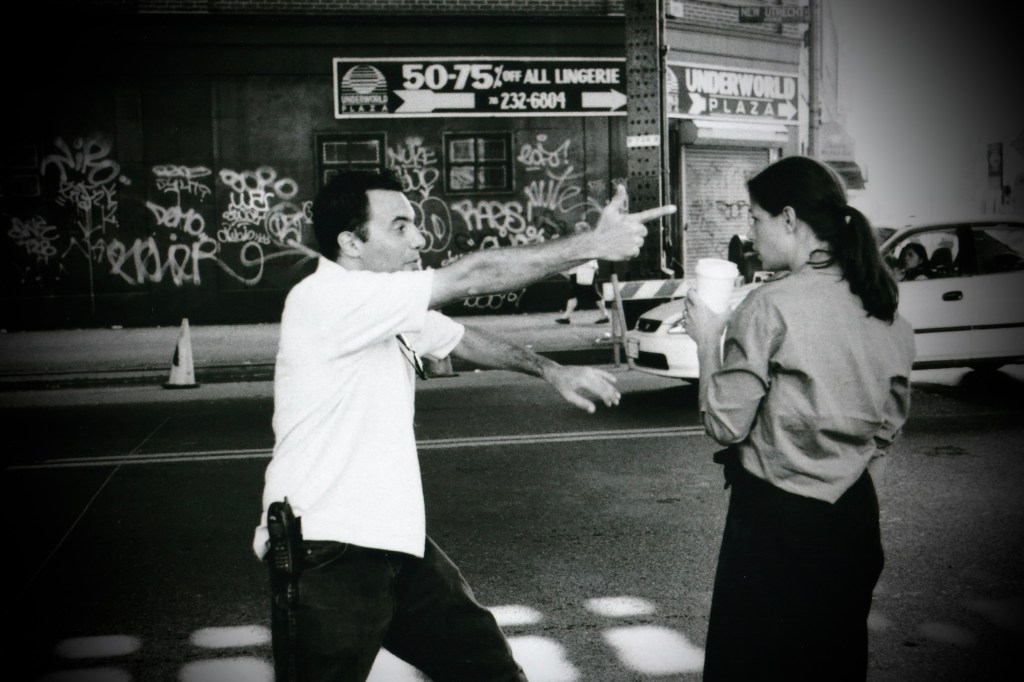
Shepard directing Maura Tierney on the set of OXYGEN (courtesy of Richard Shepard)
MEXICO CITY was next. It’s safe to say this was a time that low-budget genre films could get some backing, get a release, and with this and OXYGEN you had begun a period of genre filmmaking that wasn’t overtly comic, unlike LINGUINI. Was this a case of just becoming known as a “thriller” director from OXYGEN you could get funding for these types of films, or were you drawn to making thrillers such as these?
I love gritty thrillers and I was on a roll of getting them financed. I still hadn’t found my “voice” as a writer. I think my voice has a more comedic tone (THE MATADOR being a perfect example) mixed with genre elements. MEXICO CITY was a thriller that was pretty straightforward. I love the experience of making that movie but it’s not a great movie.
I found myself screwed after that. My financing dried up. My agent fired me. My dad got cancer. I was in a pretty bleak place, but like my experience after LINGUINI, after reaching emotional bottom, I decided to write myself out of it. I wrote THE MATADOR to make down and dirty on video for nothing, and then somehow Pierce Brosnan’s company got hold of it as a writing sample (they were looking for writers for a THOMAS CROWN AFFAIR sequel) and Pierce just liked script and next thing you know, I had 12 million dollars to make THE MATADOR and my life changed forever.
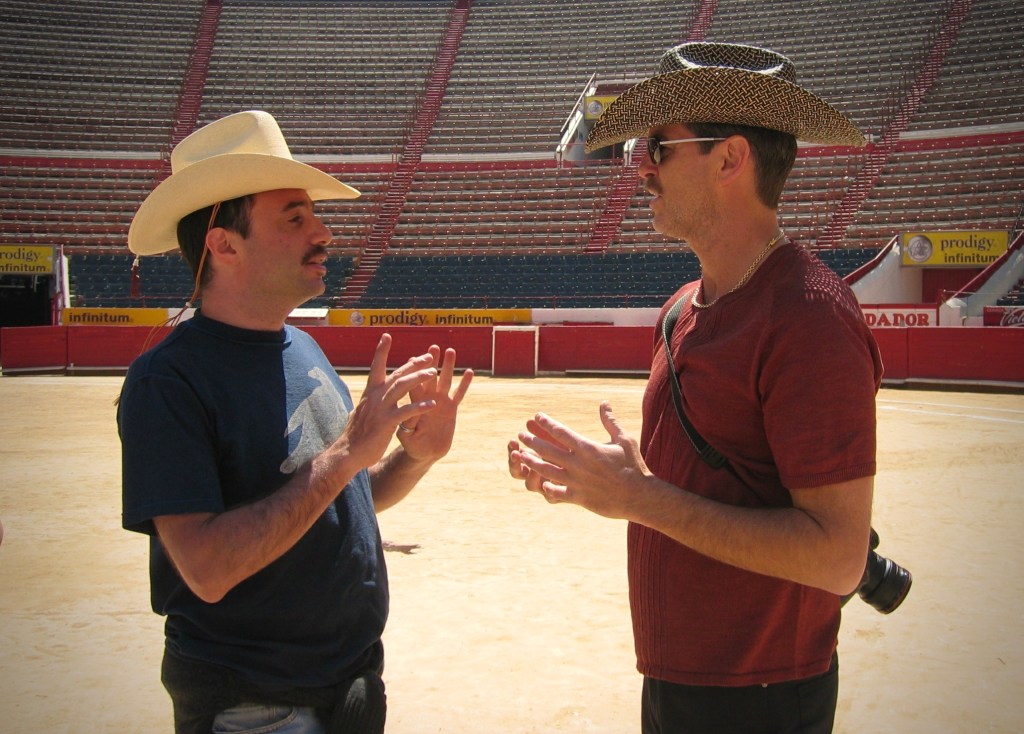
Shepard and Pierce Brosnan on the set of THE MATADOR (courtesy of Richard Shepard)
THE MATADOR was really a film that got you a lot of attention. You both wrote and directed it. Can you talk about the idea you had for this? Did you have Brosnan in mind when you wrote it?
I wrote it with Christopher Walken in mind. But once Pierce responded it became evident that it was a perfect piece of casting as he had just finished with Bond, and this was such a fucked up twist on that type of character. There was actually a line in the script where Greg Kinnear’s character says, “Are you James Bond?” We obviously cut it. THE MATADOR was the first script I wrote without an outline. I just let the characters take me where they wanted to go. It changed my entire way of approaching writing scripts and I started really finding my true voice as writer.
Many think that this might be Brosnan’s best performance. He was huge of course, coming off of Bond. Talk about what working with him was like. Did he get the offbeat vibe you were going for immediately?
Pierce was the very best and he and Greg Kinnear instantly loved each other, and we just had the best time making the film in Mexico City. A lot of margaritas were consumed. We stayed in the hotel where we filmed, and every weekend was a pool party. Sometimes a great shoot leads to a dull movie but that was not the experience here. Pierce wanted to push himself and I knew that in order for him to do his best work he needed an actor in the other role that could steal the movie if Pierce didn’t do his very best work. I fought to get Greg in the film because I knew he would push Pierce. And their chemistry was instant (I was so desperate for Greg that I flew to LA on Christmas Eve eve to meet him and convince him to do the part).
Pierce’s producing partner (the late, great) Beau St. Claire allowed me weeks of editing past the DGA mandated 10 weeks to really push to find the very best film and many of the funniest things in the film (like the shark in the pool) were found in the editing room where the tone, which is always tricky in comedy/drama was played with, experimented with, and ultimately found.
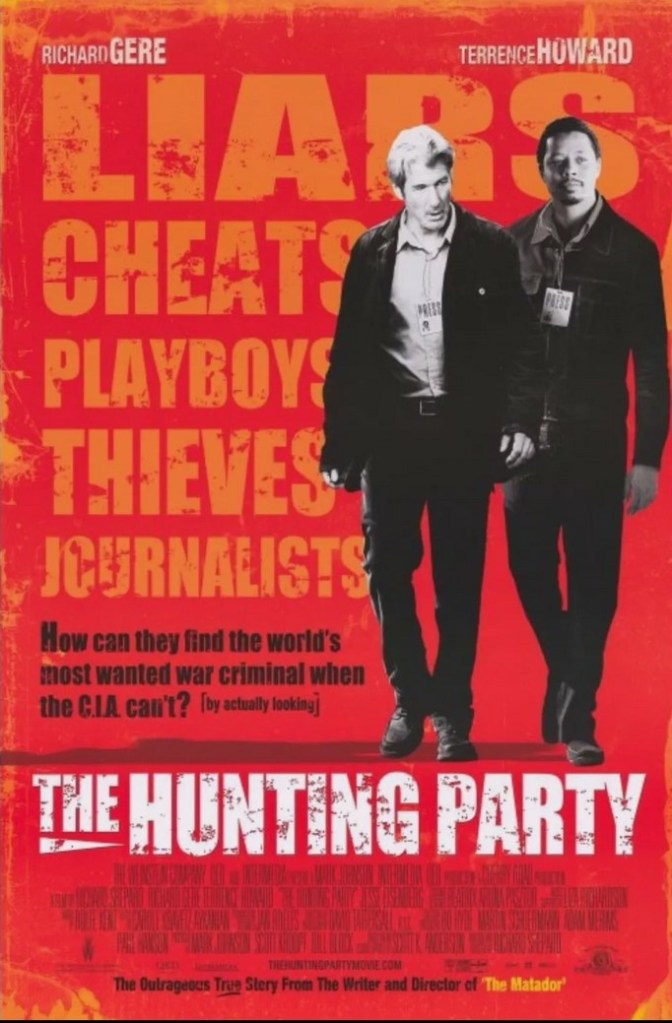
THE HUNTING PARTY is a bit overlooked (and I like the working title SPRING BREAK IN BOSNIA better)! Can you talk a bit about your feelings about this project, and how it was working with Richard Gere and Terrence Howard?
I’m extremely proud of this movie and it does break my heart that it’s basically off the radar now. Harvey Weinstein championed it, got us into Venice Film Festival, and then dumped the movie. It was tragic. But man, what an experience making it. A true story set and shot in Bosnia. Hunting for war criminals. Funny and emotional. It was the most money and time I ever had for a movie (40 days, 21 million) and we took full advantage of all of it. Gere was a pleasure, and so was Jesse Eisenberg. Just great. I really liked Terrence as well. We met at the Sundance film festival when THE MATADOR was there, as was his breakout film HUSTLE AND FLOW. He loved THE MATADOR and I remember him asking questions at the Q & A after the film! He was obsessed with how great Pierce was. I sent him the script for THE HUNTING PARTY and he said yes without even reading it.
What was it like shooting in Sarajevo and Croatia? Did they have fully established film industries? Any story about shooting in this unusual location?
At some point there was talk about shooting in Bulgaria which was cheaper and safer, but to me we had to shoot where the story took place. There were half a million unexploded land mines still in Bosnia from the war there in the 90s so we shot in Sarajevo and then the rest in Croatia. The research about why these war criminals were hiding in plain site was amazing and I hung with the journalists that the story is based on and retraced their steps looking for Radovan Karadzic (he was caught a few years after the film and sentenced by the Hague). At one point we heard he was hiding an hour outside of Sarajevo was while we were filming, and I went to his daughter’s house and knocked on her door asking if Radovan was there.

DOM HEMINGWAY is another film more people need to see, especially for Jude Law’s performance. How easy/tough is it to gauge what’s working when you’re shooting films with both dark and light elements, such as MATADOR, PARTY and HEMINGWAY? Do you feel you have a natural sensor that allows you to know when to reign it in, when to be a bit more broad, etc., or does it come together in the editing room? These films are very effective at shifting from tension to comedy, which can’t be easy to modulate when filming.
I love mixing tones. And THE MATADOR, HUNTING PARTY and DOM HEMINGWAY are a trifecta of thrillers that are also character studies that mix comedy and drama. You must cast these things correctly for them to work. With DOM I knew I wanted an actor to do something they hadn’t done before, and like getting Pierce for THE MATADOR my timing was perfect with Jude. He was looking for a shake up out of the romantic roles he had been doing. I thought Dom was sort of a larger than life sad/funny/pathetic/grand Shakespearean type character and Jude responded to that connection. We hit it off instantly. I secretly slipped off to London on a weekend as I was shooting a TV pilot in NYC to try to get Jude to commit. We spent 6 hours drinking in a pub and I was so shit faced that I barely knew if he said yes or not, but we just instantly connected and then somehow 5 months later we were shooting. It was a fast shoot, 24 days, but I was able to rehearse with Jude and Richard E Grant and the cast extensively on or actual locations beforehand so were able to shoot quickly as much of the creative questions had been answered. An 8-page scene at the house where Jude confronts Demian Bechir, with Richard E Grant watching, which is basically a giant monologue on Dom’s part, was shot in one day. But we had rehearsed extensively.

2018’s THE PERFECTION is your first horror film. Did you enjoy making it? Did you find it a genre that you slipped into easily?
I love nearly all genres of film, and I know I would have loved being a 1940s studio filmmaker going from film to film and genre to genre. That’s one of the reasons I love doing TV pilots. I can go from UGLY BETTY to CRIMINAL MINDS. I had this idea for a horror film and pitched it to Eric Charmelo and Nicole Snyder who I had done a pilot for and we wrote it pretty quickly. I knew and loved Allison Williams from directing GIRLS for 6 years, so I offered her the part and we it all just came together quickly. A 4-million-dollar budget, 24 days (including 2 in China!).
You’ve taken time to make some impressive documentaries, starting with your John Cazale profile I KNEW IT WAS YOU and, most recently, FILM GEEK. What are the unique challenges and satisfactions of making documentaries?
Doing documentaries or short films is a great way to keep working between higher paying projects that sometimes take forever er to come together. I also just love working. Telling stories. The Cazale doc was something I really wanted to make as he was always my favorite actor even before I knew his name. With the success of the THE MATADOR I was able to leverage it to start the doc. I spent a year trying to get Meryl Streep to talk with me, (she had been Cazale’s girlfriend and had cared for him as he died at age 42) and when she finally agreed everyone from Pacino to De Niro to Coppola to Sidney Lumet to Gene Hackman agreed. It was film geek heaven for me, meeting so many of my heroes. FILM GEEK itself was started during COVID lock-down and was a very personal history of my youthful life of film and my mysterious dad.
You have directed a fair amount of notable television in the 21st century. Can you tell me anything about your 30 ROCK episode (one of my favorite shows)? You’ve directed a lot of pilots, but when you come into a show like ROCK that’s already established, do you find it difficult to direct the actors as they’ve played the part before and will again after you are there, or do they appreciate when you have a suggestion?
Directing pilots for TV is a lot like making an indie film. You get a chance to help create the tone, help in casting, creating the show from the ground up. Series directing is a different animal. You’re coming into a well-oiled machine. Some shows like GIRLS really encouraged me to make my personal mark, others you just try to not fuck it up. But it can be really fun. 30 ROCK was a favorite show of mine and I asked if I could direct an episode just to be a part of its legacy. Alec Baldwin would self-correct, so he would stop in the middle of a take and redo a line he felt he missed and that would continue until the end of the scene so by the time I said cut there was no need for a take two. Tina Fey was one of the most talented people I’ve ever worked with. I’m pretty sure I didn’t give her one piece of direction. But man, that cast, and those writers are top of the line.

Finally, circling back to LINGUINI; this is in a certain way your first directing effort AND your most recent in that you’ve gone back and recut the film quite a bit for this new release (and provided both cuts on the Blu-ray release). Can you talk a little about your recut?
Revisiting that movie brought back many painful memories for me, yet the thought of being able to get a cut of the film closer to what I had originally intended was certainly intriguing. So many filmmakers have had issues with their movies— films butchered and recut and dumped– but how many have had a chance to correct them? Plus, here was this David Bowie film that most people, even his fans, had never heard of. With a romantic, funny performance by him that was like no other. It was exciting to think of bringing it back for people to check out. Thirty years can be very forgiving.
David Dean, who had edited several pilots for me (ZOEY’S EXTRAORDINARY PLAYLIST, ACAPULCO) , along with my movie THE PERFECTION, offered his editing services in exchange for a good—sorry, make that very good—bottle of scotch. We had no access to the dailies, no split tracks (which meant where there was originally music, there would still be music), and we only had the 1 hour 45-minute European version to work with, but that was fine. The movie I wanted was going to be jaunty 90 minutes or so, with shots reframed, zooms added, sequences re-ordered, dialog tightened, and cool moments added that had never been seen in the U.S. There were scenes that only had three angles in them, but by reframing digitally, it suddenly felt like there were 6 or 7 shots. This added pace and helped the humor. Of course, there were things I couldn’t fix. Missed comic moments, uninteresting angles and blocking, a bit player whose performance couldn’t be saved thirty years ago, or today. Rookie mistakes that were forever cemented in celluloid. Would I have loved access to the original dailies so I could look for varied takes, different coverage, more magic— sure. But I only had what I had. Still, we changed and tightened and noodled and breathed life back into THE LINGUINI INCIDENT. It suddenly felt fresh, funny, and unique to me. I knew that there were serious fans of the original film– My goal was to not destroy the movie they liked; it was to just make it a film that I liked too. It’s not perfect. Not a lost masterpiece, for sure. But it’s finally MY not–a-lost masterpiece!


 Tremble...Sigh...Wonder...
Leave a reply to Rediscovering Obsession: A Conversation with Richard Shepard on his movie FILM GEEK, airing on TCM next weekend – Tremble…Sigh…Wonder… Cancel reply