
by James Kenney
Fog of War is one of those low-budget WWII period pieces that have shown up a bit the last decade as CGI (and whatnot) makes it easier to create period airplanes (and such) than it used to be. It announces some intriguing ambitions early and then spends the rest of its running time quietly undoing them. Set on a remote Massachusetts farm during World War II, one where incredible fog rolls in (symbolic of the fog of war!) and big cliffs are nearby, the film positions itself as a cloistered wartime mystery, part espionage thriller, part domestic melodrama, where everyone is potentially lying and the truth is hidden just beneath terse, polite conversation and all of that fog.
I wanted to embrace this, and for a while, it almost works. The early stretches suggest a sharper, more psychologically charged movie than the one we ultimately get. There’s an intriguing promise in the setup: a wounded pilot and his intelligence-connected fiancée arrive at her uncle’s home, and suspicion immediately begins to circulate. The film briefly hints that the central conflict might hinge on a battle of wills between the traumatized young protagonist and the uncle played by John Cusack, a dynamic that could have supported a tense, actor-driven chamber piece, as Cusack, as eccentric as he’s become the last ten years or so, still has the chops to pull off.
But, no, we don’t get that. As it is a period piece, Cusack can’t resort to the baseball umpire ensemble he’s chosen for most of his last decade of straight-to-video work, but he does keep his hat on for pretty much the whole movie as a trade-off. And anyway, Cusack is barely involved, vanishing for long stretches of the film at precisely the moments when the drama seems to demand his return (as does Mira Sorvino as his wife who might be the most interesting character in the movie, but is hardly in it as well). Their absence becomes so conspicuous that it starts to feel like they walked off the set early, and director Michael Day never got all their scenes shot. In any case, what remains is a mystery that’s both over-signaled and underdeveloped: simple in conception, yet convoluted in execution.
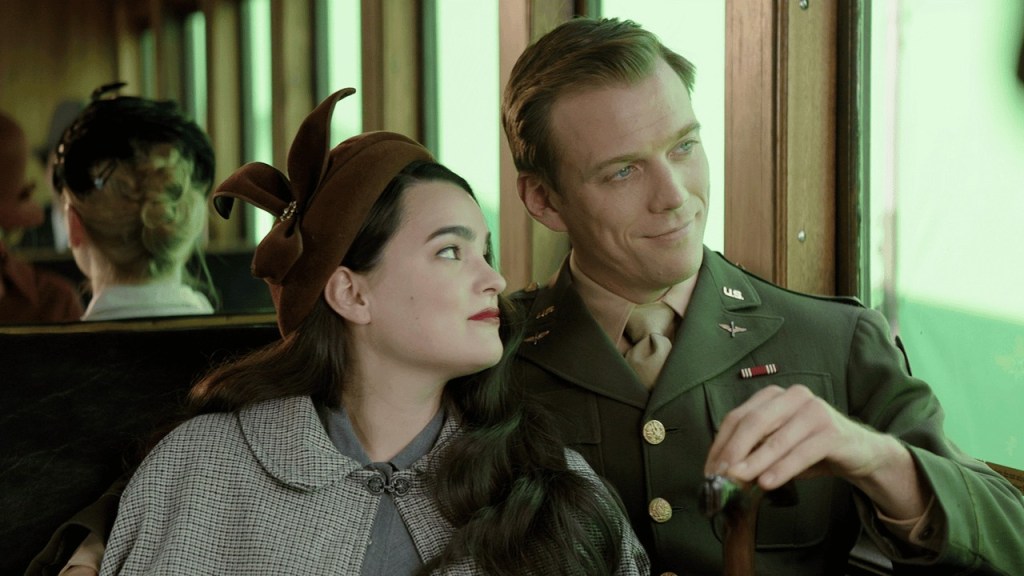
The central problem is that the film telegraphs its big reveal far too early. I find myself asking, maybe twenty minutes in, Is that the twist?—and then spending the rest of the movie waiting for confirmation. When it finally arrives, the answer is essentially, Yup. That was it. The suspense drains away not because the idea is inherently bad, but because the movie never meaningfully complicates it, and the leads Jake Abel and Brianna Hildebrand, aren’t especially compelling (it should be added the film has too few characters, leaving us to mull the limited characters on screen far too much). Character behavior, line readings, and staging all give the game away long before the script thinks it has.
Cusack and Sorvino do competent work, as does Géza Röhrig (seen to better effect recently in Marty Supreme) as a character seemingly so villainous in the first third you know he can’t be, while the younger leads struggle. Abel does lots of skulking around, and Hildebrand’s character is so confusingly presented I don’t know what to make of her efforts, really. Everyone seems to be playing toward a revelation the audience has likely already clocked, which leaves the final act feeling like a formality.
Fog of War briefly suggests a mildly rigorous, character-driven thriller, before retreating into safe, TV-scale melodrama. Day’s direction is too obvious to be genuinely suspenseful, yet too self-consciously murky to be cleanly simple. I spent most of the film faintly puzzled, wondering where the better version of the movie I promised myself in the first reel went.


 Tremble...Sigh...Wonder...
Leave a comment