by James Kenney
“My pictures are mine. Individual and special.”
Larry Cohen, interviewed by Maitland McDonagh, Columbia Film Review
“When I write, I’m watching the movie in my head, imagining it. I want to be in it. I don’t like to see words I’m writing.”
Larry Cohen, quoted by Amy Wallace in The New Yorker
“My basic education was going to the movies… I just assimilated it. I knew structure and form and just inherently could do it…. If you can jump in at an interesting situation with interesting characters and let them take you for a ride, and allow the characters to come to life, then you can’t wait to get back to writing the next day because you’ll be excited at where they take you.”
Larry Cohen, in Screenwriters Monthly
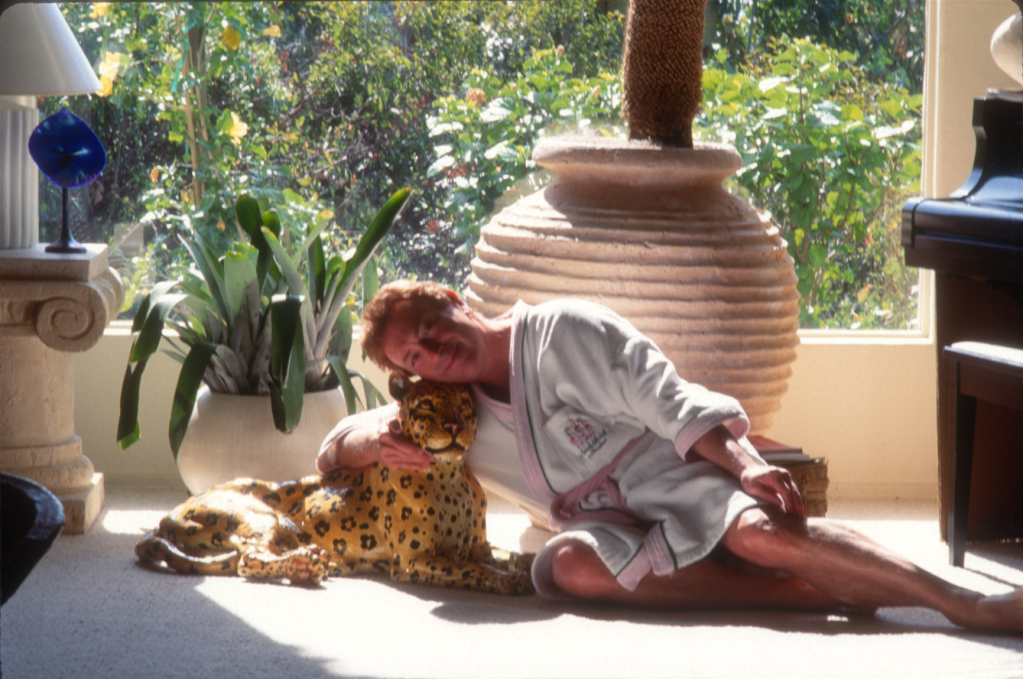
Filmmaker Larry Cohen’s name is less familiar to the general public than to critics and aficionados of cult cinema, yet to those attuned to his work’s subversive power and rough-hewn vitality, he endures as one of the medium’s most inventive figures, conjuring mutant infants, winged serpents and killer desserts into narratives that operate at once as pulp spectacle and as sharp critiques of contemporary society.
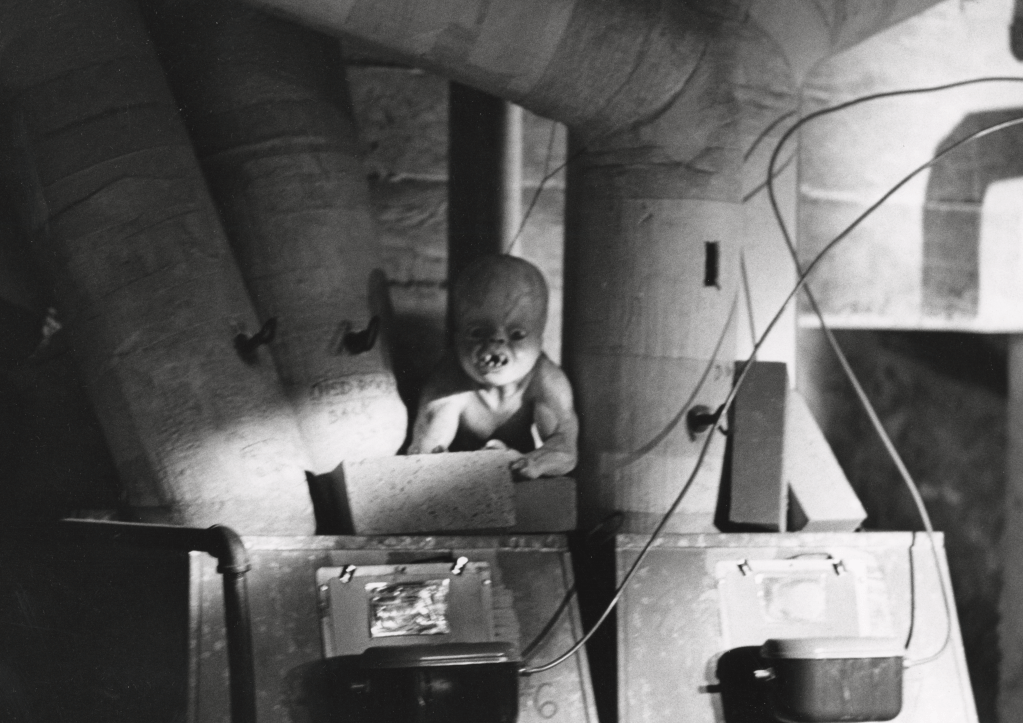
The late filmmaker’s flair for provocation extended beyond the screen. In mid-1970s London, Cohen had baby carriages roll through Piccadilly Circus, each marked with a sign that read, “If you want to see the baby, you’ve got to go and see It’s Alive.” Shoppers were startled to hear demonic infant growls from inside the carriages, a bit of carnival ballyhoo that was pure Cohen: humorous, shocking, and wholly in service to his art. He might bait you with William Castle-style stunts to see his film, but the twist was that you paid your money for a genuinely great film.
Cohen carved a renegade path, cutting his teeth as a teenage stand-up comedian, then muscling into television in the 1960s with scripts for The Defenders and creating the western Branded and the X-Files precursor The Invaders. From there he moved on to writing, producing, and directing theatrical features, ruling as a one-man-band auteur for two decades, banging out singular genre landmarks like Black Caesar and Q: The Winged Serpent. And as other writers’ phones stopped ringing, Cohen’s kept buzzing, when in his mid-sixties he reinvented himself as a well-compensated Hollywood gun-for-hire, penning the sleek studio thrillers Phone Booth, with Colin Farrell. Through it all, he remained the quintessential guerrilla filmmaker: unconventional, resourceful, never once weary of the hustle.

In an era when B-movies were dismissed as disreputable grindhouse fare, Cohen used them as his personal sandbox to play with big ideas. He smuggled social satire and sharp commentary into drive-in horror flicks and crime capers with titles like Hell Up in Harlem and It Lives Again (a sequel, naturally, to It Lives), pushing exploitation films into territory at once sharper and more daring than the market ever demanded. And he did it all with a mischievous grin and a truly eccentric flair.
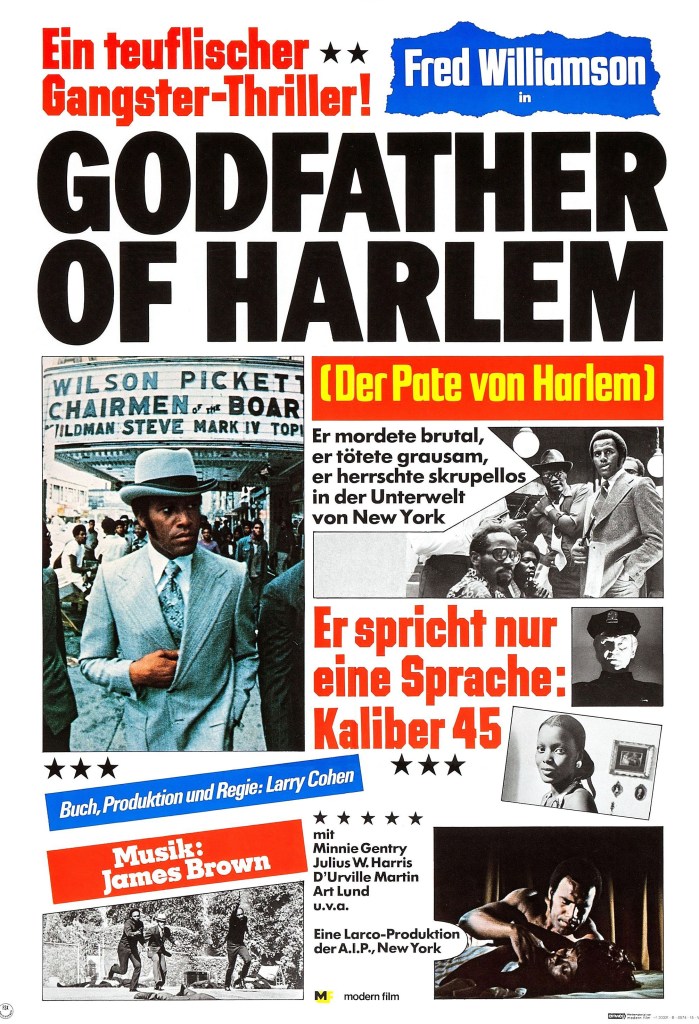
Directed by Larry Cohen
Beneath the rubber creatures and explosive squib-laden shootouts, his films carried an undercurrent of meaning, a drive to engage with real conflicts and anxieties. Speaking to interviewer Geoffrey McNab, Cohen himself insisted, “I want the picture to be about something – not just action and violence.” That insistence on significance marked Cohen as an anomalous figure within exploitation cinema, transforming disreputable forms into vessels for cultural provocation, collapsing the boundary between low-budget spectacle and serious cultural discourse. Even as his films unspooled as 42nd Street double features, they were being subjected to rigorous deconstruction by no less than Robin Wood in Film Comment.
Cohen made low-budget genre films not because he was forced to, but because he loved them—relishing the freedom of style and subject matter denied to bigger-budgeted Hollywood productions. His work pulsed with anarchic vitality and a slyly mordant wit, fusing the garish with the deeply psychological, and grinding pulp into something sharper, more disquieting. On the surface, his films often begin with “high-concept” premises—a winged serpent attacking New York, unrelated strangers committing murder while muttering “God told me to,” a hitman romancing the mother of a small child who witnessed a murder. Underneath such baroque spectacle lurked nightmares drawn directly from daily anxieties.
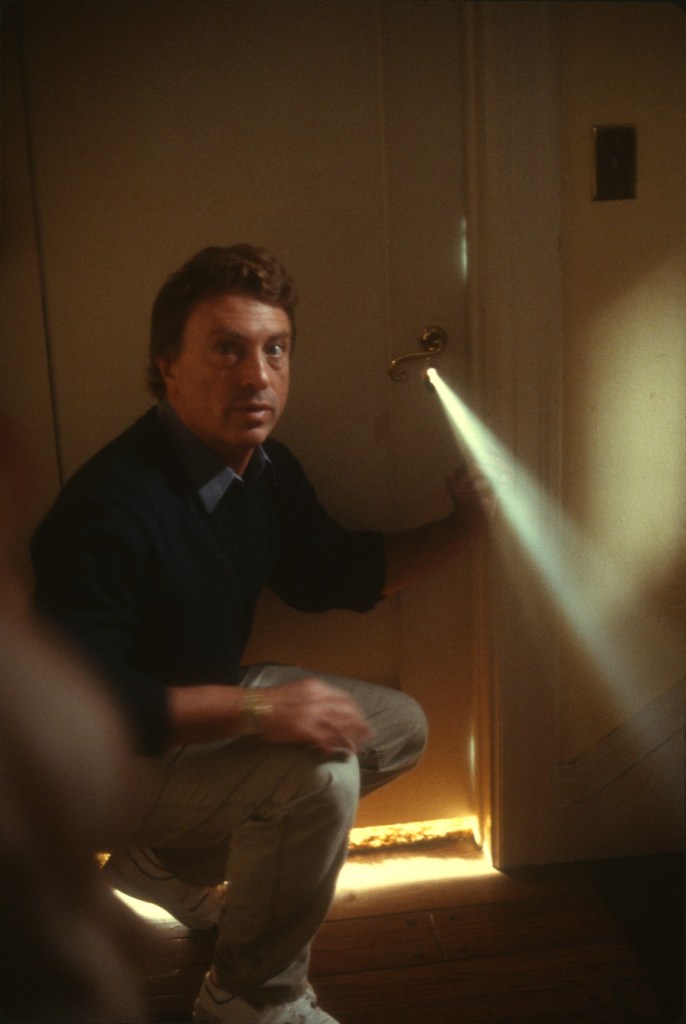
His films blend horror, comedy, and action, tackling topics like racism, abortion, consumerism, religion, and the American family – all articulated within the popular idioms of horror, science fiction and pulp violence. Brash and self-assured, Cohen emerged as a rare triple threat—writer, producer, and director—driven by a restless imagination and a taste for provocation.
In The Invaders, aliens disguise themselves as humans while only one man knows the truth (Cohen later called it “a parody of the McCarthy years, a witch hunt of aliens”), while Branded is a Western about a “blacklisted” cowboy, a conceit that earning the disapproval of right-wing star Chuck Connors. By the 1970s he had turned his energies toward cinema, staking out territory across a startling range of genres: Blaxploitation with Black Caesar (which he insisted was “a film about family life”); horror with It’s Alive (Cohen to Sight and Sound: “I don’t think It’s Alive is more of a horror story than The Elephant Man”); paranoid science fiction in God Told Me To (where an alien is mistaken for a messiah, Cohen telling The New Yorker he was “inspired by America’s emerging gay culture”); political exposé in The Private Files of J. Edgar Hoover (his answer to Jimmy Stewart’s “whitewashed” The F.B.I. Story); and satiric black comedy in his directing debut Bone, an acerbic portrait of liberals scrambling to mask their own prejudices. As writer Tony Williams observed on the website Senses of Cinema, Cohen “utilized radical allegory” in It’s Alive to mount an ironic critique of one of America’s most cherished icons—the family. The film mobilized the horror genre as a site for exploring the psychic repressions of the nuclear family, exposing how parental anxieties about their children’s differences or unpredictability can metastasize into nightmare. This kind of sneaky social commentary was Cohen’s forte.
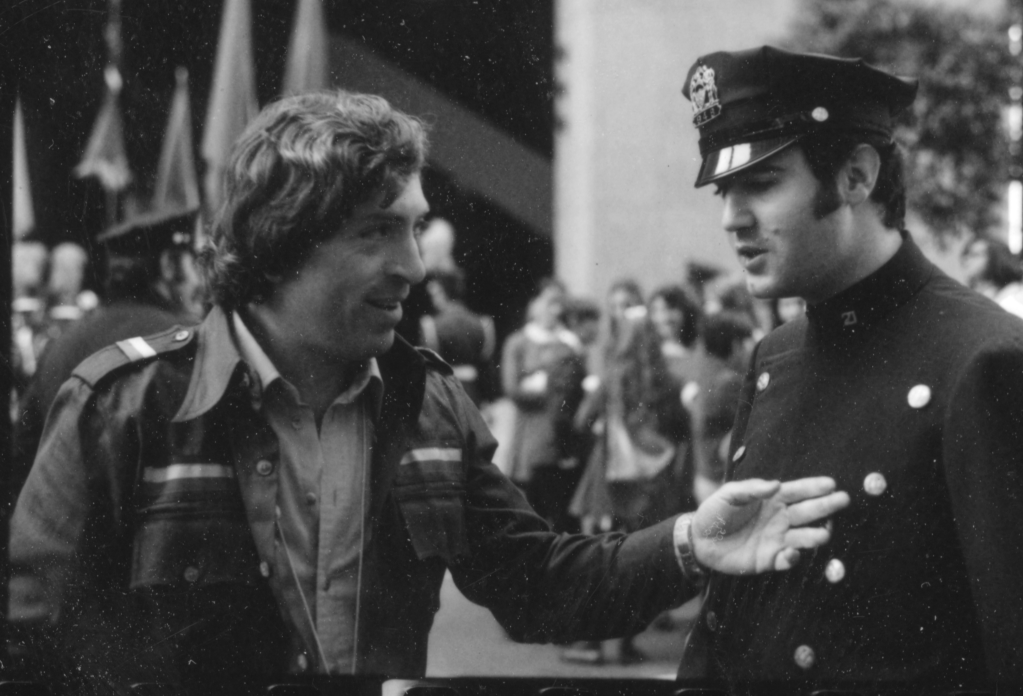
Cohen continued turning out uniquely offbeat films. In 1976 he gave the world God Told Me To, a provocative thriller in which random New Yorkers suddenly become spree killers, all claiming divine instruction. What begins as a crime mystery veers into science fiction and blasphemous satire, encompassing Cohen’s stunt of planting a young Andy Kaufman, in full police uniform, into the real New York City St. Patrick’s Day parade, where he suddenly obeys God by pulling a gun and firing into the crowd as Cohen’s cameras rolled. It wasn’t only the content that defied convention but the form itself. Cohen shot with the same audacity that charged his stories—driving cabs onto sidewalks in midtown Manhattan, staging fistfights at the baggage claim in Los Angeles International Airport, hijacking public events as ready-made sets. The result was cinema that felt reckless and alive, its provocations inseparable from the way it was made.
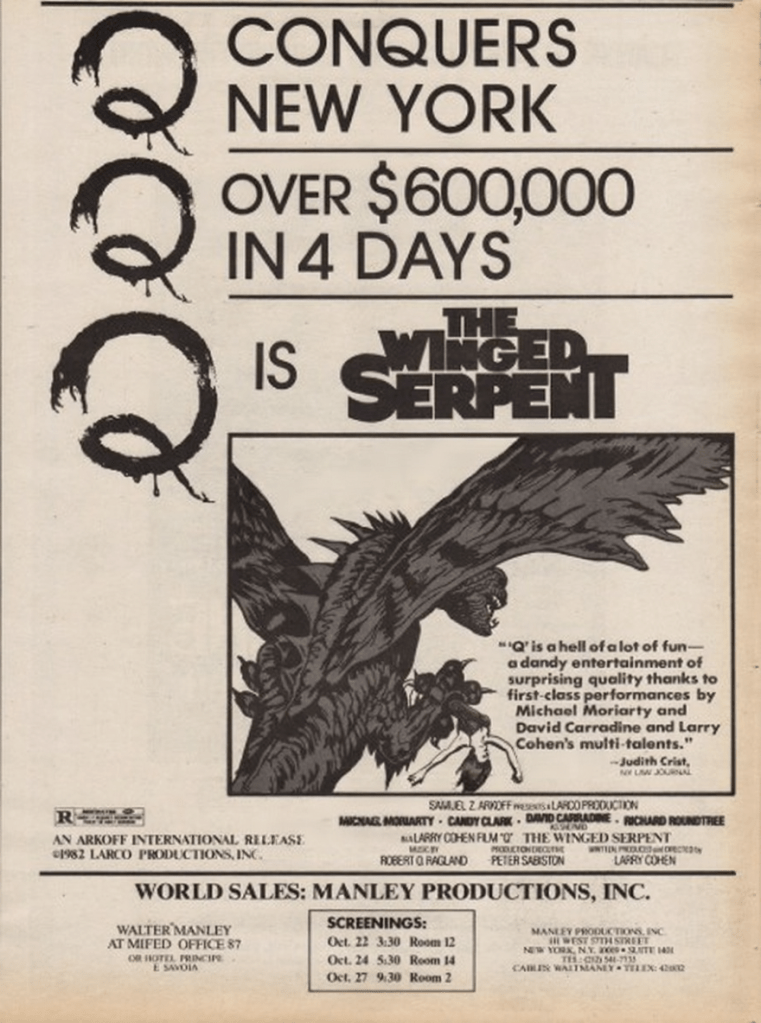
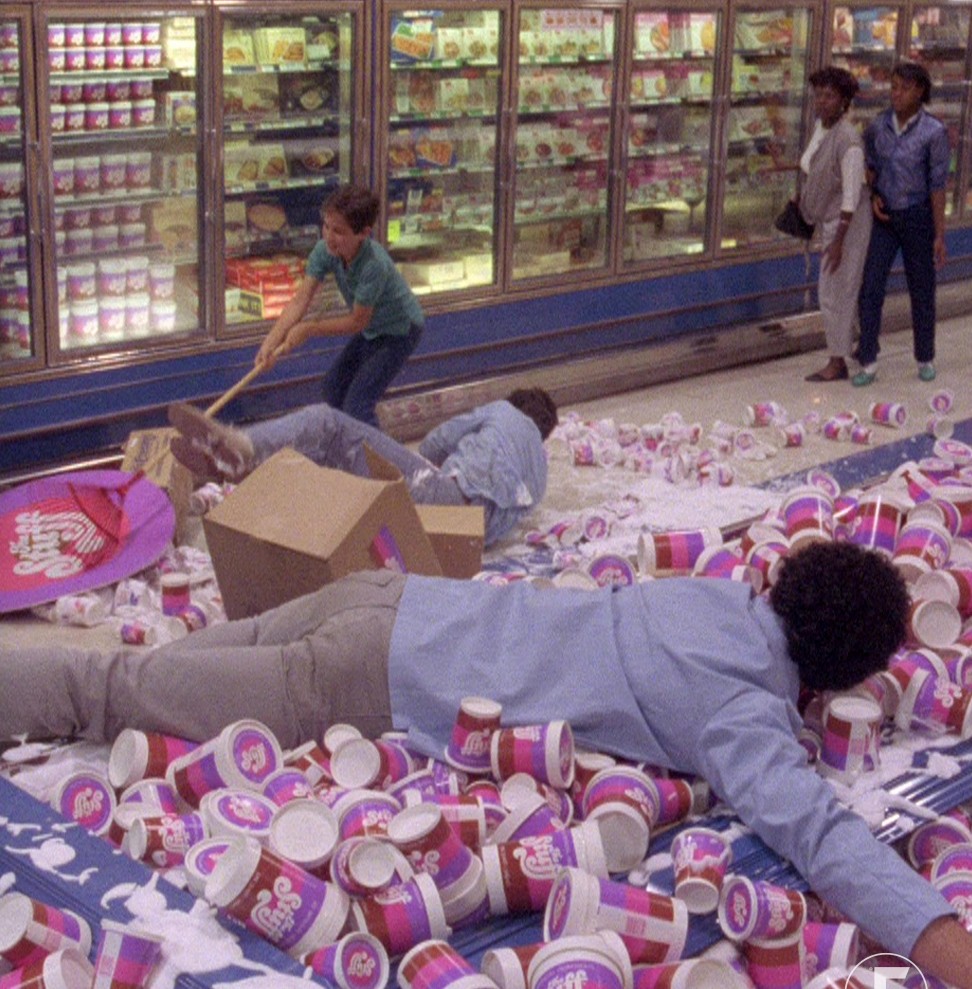
By the 1980s, Cohen’s bravado had become so conspicuous it was making headlines. Q: The Winged Serpent turned the Chrysler Building into his personal backlot, complete with phony NYPD officers led by David Carradine firing machine guns from its turret high above Midtown, a spectacle that collapsed the line between cinematic fantasy and urban reality, resulting in New York Post headlines and admonishment from Mayor Ed Koch. Cohen followed it with The Stuff (tagline: “Are you eating it, or is it eating you?”), a satirical horror film in which the allegory is scarcely disguised: consumers eagerly embrace a substance that consumes them in turn, a junk-food monstrosity extending Cohen’s critique of American appetites into the terrain of body horror.
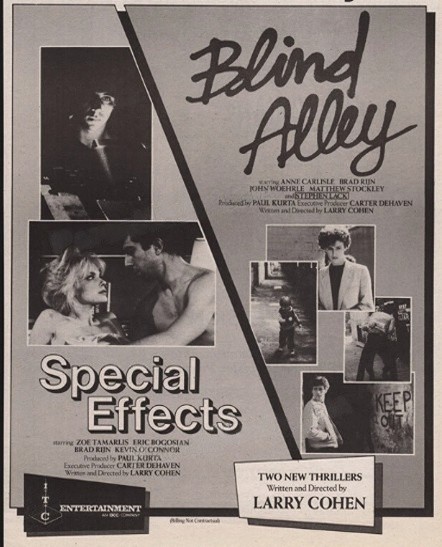
Throughout the decade, Cohen kept commandeering Manhattan as his stage, turning out scrappy indies like Perfect Strangers and Special Effects, utilizing local counterculture figures like Eric Bogosian (Talk Radio), Zoë Tamerlis (Ms. 45), and Ann Carlisle (Liquid Sky) as his leads. At the same time, he cultivated a reputation for professional volatility, deliberately getting himself fired from higher-budget assignments such as I, the Jury—where he admitted he had planned to subvert Mickey Spillane’s Mike Hammer—and Deadly Illusion, since quitting outright would have left him open to lawsuits. Both films suffered fatally in his absence, their strongest moments all traceable to Cohen’s characteristic, original scripts.
Commentators often remarked on the ferocity of Cohen’s vision. In the late 1970s, Robin Wood argued that “the work of Larry Cohen…does not offer an alternative, except by implication, to a society perceived as locked in the processes of its own self-destruction.” For Wood, even films dismissed by mainstream critics revealed unexpected depth: It’s Alive, widely written off as a “Rosemary’s Baby–Exorcist rip-off,” was, in his view, “more intelligent than either, and owes them about as much as Rio Bravo owes High Noon.” Regarding God Told Me To, Wood observed that “the issues it opens up are both immense and profound, and absolutely central to our culture and its future development.”
Throughout his career, other critics echoed this sense of Cohen as a filmmaker whose pulp surfaces masked something more subversive. Upon reviewing The Stuff in 1985, The Village Voice hailed it as “something like Herbert Marcuse meets the Blob”; Marcuse, the Frankfurt School philosopher of consumerist critique, alongside The Blob, a 1950s monster movie. This improbable pairing—highbrow social theory meeting unabashed B-movie nonsense—captures exactly the kind of hybrid genius that made Cohen’s work so distinctive.
Some years later, writing in the New York Times, Elvis Mitchell devoted an essay to “Larry Cohen’s Art of Paranoia,” praising how “Cohen’s ideas have a B-picture power surge… at his best, he creates projects that center on stripping away skin, nerve endings, and, ultimately, pretense. Cohen can find entertainment in the belief that ignorance and insanity go hand in hand.”

The mainstream press continued to catch on. The New Yorker did a profile of Cohen, and as New York Magazine put it in 2003, “Larry Cohen turned the grindhouses into arthouses, and the raincoat crowd didn’t even mind,” the article celebrating his “weird greatness” across a “long, weird career.” Cohen himself embraced his B-movie tag, wearing it like a badge of honor. He once quipped that he was the John Cassavetes of exploitation cinema, which is less absurd than it sounds. If Cassavetes pioneered personal, independent filmmaking in the arthouse, Cohen brought the same renegade spirit to the grindhouse.
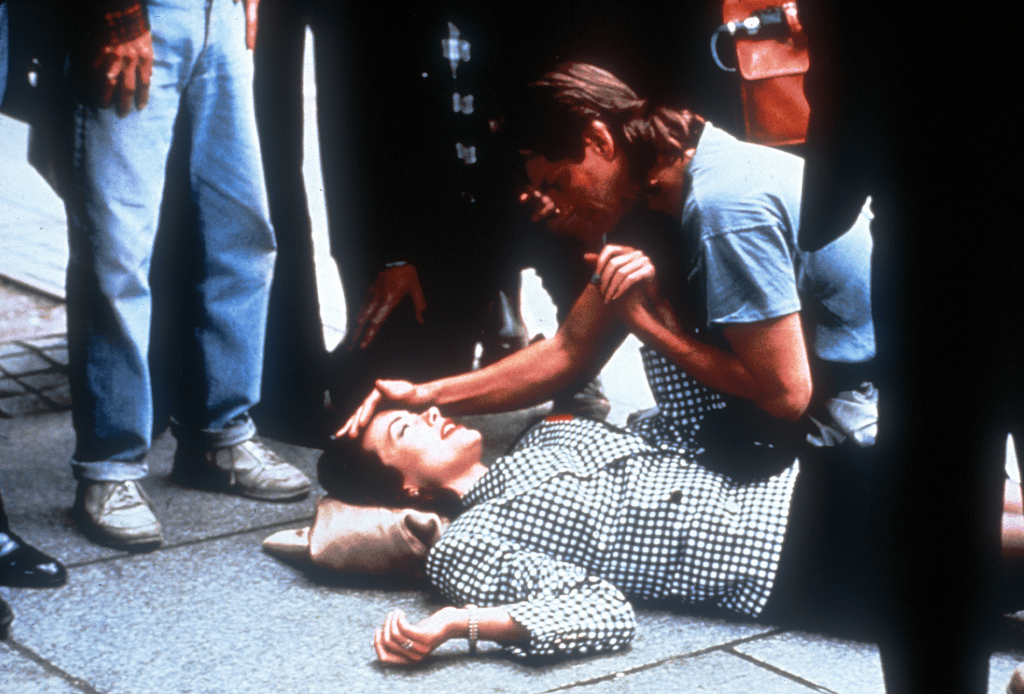
In a 2025 essay for The Quietus, John Dornan characterized Cohen as “the Jonathan Swift of NYC,” underscoring how firmly his reputation for savage social satire has endured within contemporary critical discourse. Cohen himself was always unapologetic about his eclecticism: “My pictures have a diversity to them… they’re all bizarre ideas, but every one of them takes you to a different world.” That spirit shaped both his methods and his movies. Cohen turned out high-concept romps with ideas bigger than their budgets, and his approach was simple: make the film “by any means necessary.” If that meant shooting in the New York Times building (without permits), staging a gunfight at Grant’s Tomb (without permits), or having Janine Turner pretend to pass out on a 5th avenue sidewalk while unsuspecting bystanders looked on (without permits), so be it. Chaos wasn’t a problem—it was the point.
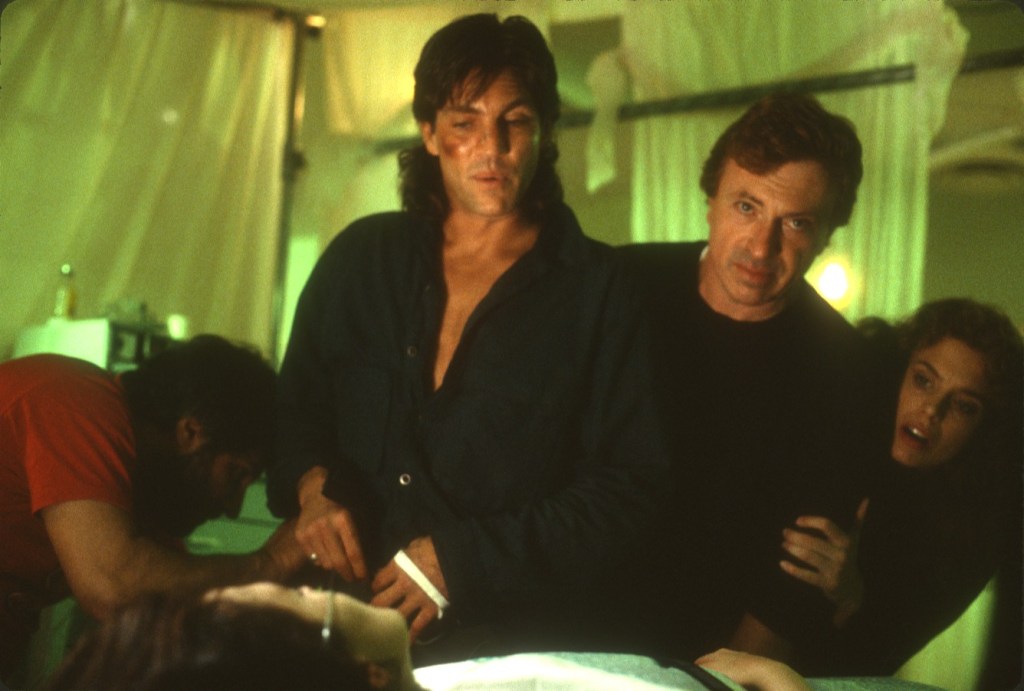
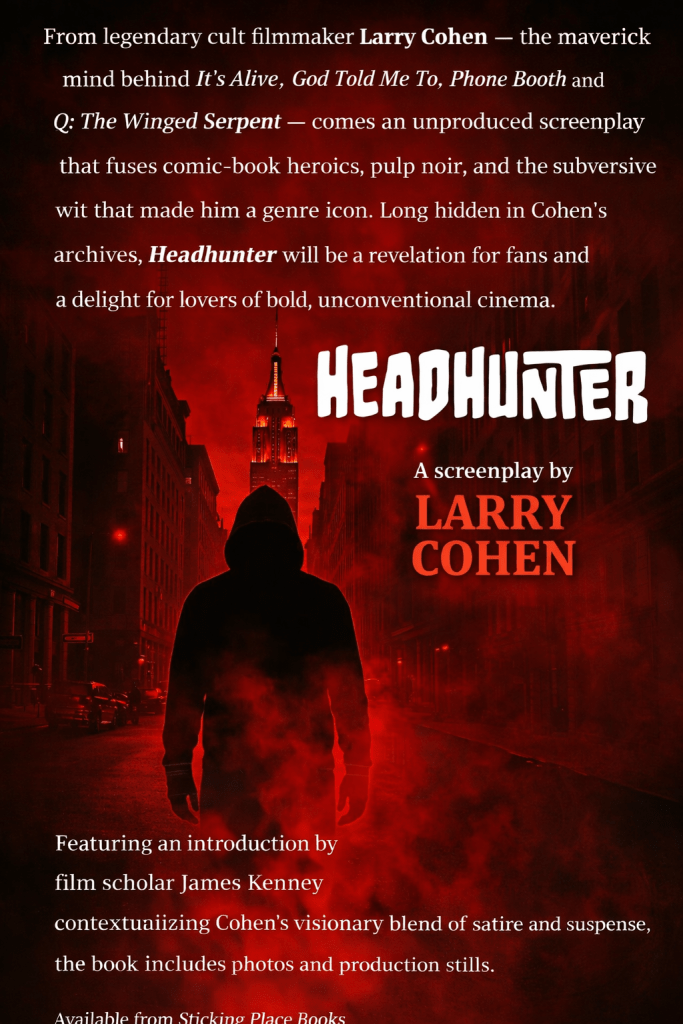
Cohen’s final self-written, self-directed theatrical feature was The Ambulance, a mordant urban fantasy in which a mysterious emergency vehicle prowls New York, collecting patients it never delivers to hospitals. Eric Roberts plays a Marvel Comics artist, trading banter with Stan Lee in the artists’ bullpen, where original comic art adorns the walls. Cohen commissioned Gene Colan to create a striking illustration for his unproduced screenplay Headhunter—artwork that can be glimpsed hanging in the bullpen scenes of The Ambulance.
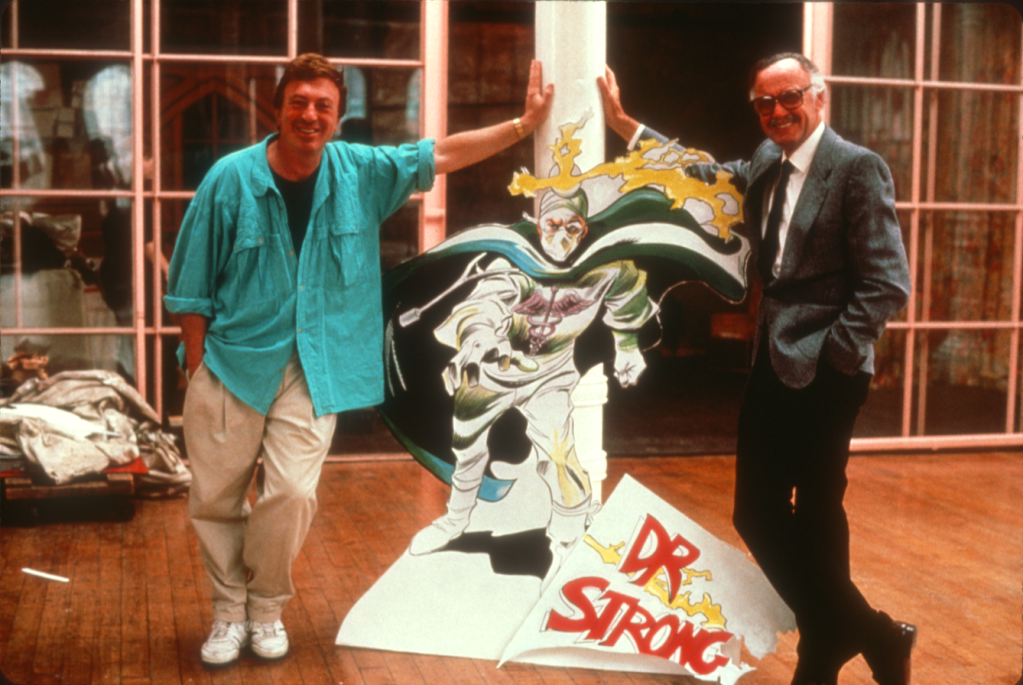
Cohen recalled to Sight and Sound that his “first childhood hobby was drawing comic books,” elaborate stories with “characters, surprise endings—quite adult in terms of content.” That early fascination never left him. In the mid-1980s, he developed an unrealized Doctor Strange project for Marvel and Lee. Headhunter feels like the culmination of that lifelong obsession with comics, pulp invention, and urban paranoia. Its Phantom Physician is at once a costumed superhero and a quack doctor—a character springing from Cohen’s comic-book imagination but refracted through the grit and volatility of New York street life.
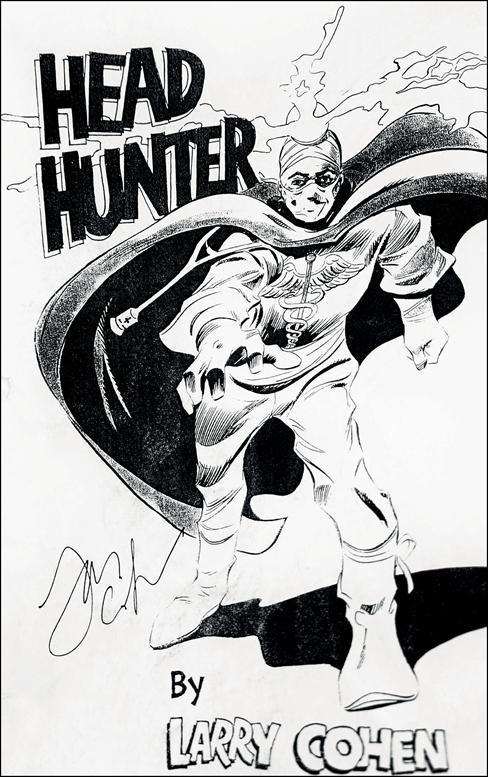
Robin Wood argued that Cohen’s work pivots on two recurring elements: the refusal of the “hero” and the motif of the double. Headhunter brings both to the surface. Kenneth Archer is no stable savior but a fractured figure, a failed doctor whose vigilante persona may “cure” criminals yet also embodies coercion and moral compromise, leaving audiences unsettled rather than reassured. His masked alter ego is simultaneously physician and executioner, healer and menace; the criminals he reprograms are distorted rather than redeemed, their violence redirected but not exactly erased. Headhunter thus dramatizes precisely what Wood identified as Cohen’s bleak vision: society cannot repair itself, for its monsters are not aberrations but mirrors held up to its own anxieties. The Phantom Physician is such a hybrid creation—superhero and charlatan, outlaw and quack, comic-book fantasy refracted through the volatile materiality of New York street life.
The script’s high-concept hook—a masked doctor who stalks the streets of New York at night, “curing” criminals with brain lasers—is outrageous yet instantly memorable. All of Cohen’s signatures are present: New York seized as guerrilla backlot, pulp invention fused with urban paranoia, satirical flourishes that warp genre expectations. The set-pieces escalate with bravado, from courthouse gas attacks to “Phantambulance” chases and neon-lit explosions, spectacle no doubt straining against the limits of what would be Cohen’s modest filming budget. Tonally, the script veers between comic-book camp, grotesque horror, and earnest melodrama. In Hollywood hands, such volatility might have been sanded into conventional smoothness; in Cohen’s, it remains jagged, unpredictable, unmistakably his.
Larry Cohen passed away in 2019, leaving behind over a half-century of wild invention and razor- sharp wit. In his later years, Cohen found fresh financial success and belated Hollywood recognition. Yet as he joked to the Los Angeles Times, working as a writer-for-hire meant “sit[ting] down with producers, and producers are a real pain in the ass, believe me.” When asked in Screenwriter’s Monthly whether he would eventually regret not directing the hit Phone Booth
himself, he answered, “I already regret it.” Whenever possible, he preferred the chaos of independence, where he could do it his way—and only his way.
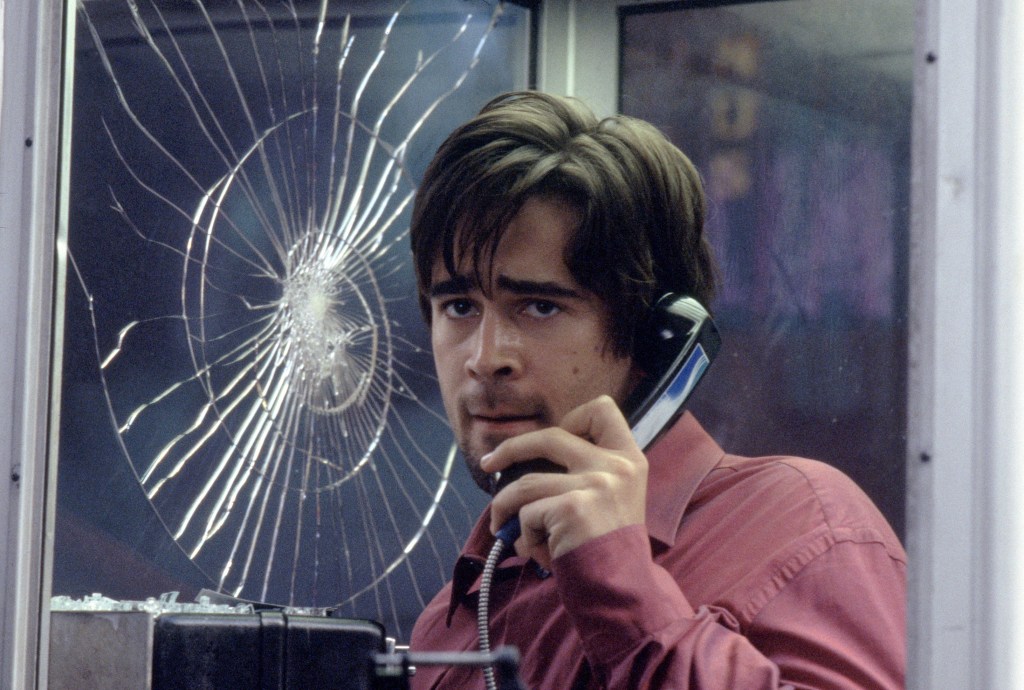
In his 77 (or perhaps 82) years—his disputed birthdate being perfectly in keeping with a life of tall tales—Cohen did it all: television and film, big screen and small, hits, flops, and everything in between. Repeatedly, he proved that significant ideas do not require significant budgets; with enough chutzpah, a filmmaker could smuggle biting social critique into the unlikeliest of genres, whether a creature feature about homicidal infants or a satire about sentient yogurt. He made the outrageous into the outrageously insightful, always in his own voice, always on his own terms. And so it is with Headhunter.
Because Headhunter was never produced, it remains uncorrupted: Larry Cohen’s singular vision preserved on the page, undistorted. In that sense, it is still wholly his— bizarre, brilliant, and to use his own words, “individual and special.”
Headhunter is available from Sticking Place Books.



 Tremble...Sigh...Wonder...
Leave a comment