
By James Kenney
For roughly its first two-thirds, The Rip feels like it’s flirting with something genuinely tense and stripped-down — a claustrophobic pressure cooker that plays like a hybrid of Assault on Precinct 13 (replete with a quietly droning synthesized score in the John Carpenter mode, all low-frequency unease and slow-building menace) and De Niro and Pacino’s Righteous Kill. Set almost entirely over one night in an isolated Miami stash house, the film locks a squad of elite cops into a moral and physical siege once they uncover over two million dollars in cartel cash hidden behind the drywall. The danger isn’t just outside –cartel operatives and crooked local cops circling in the darkness — but internal, as paranoia spreads and loyalties fracture.
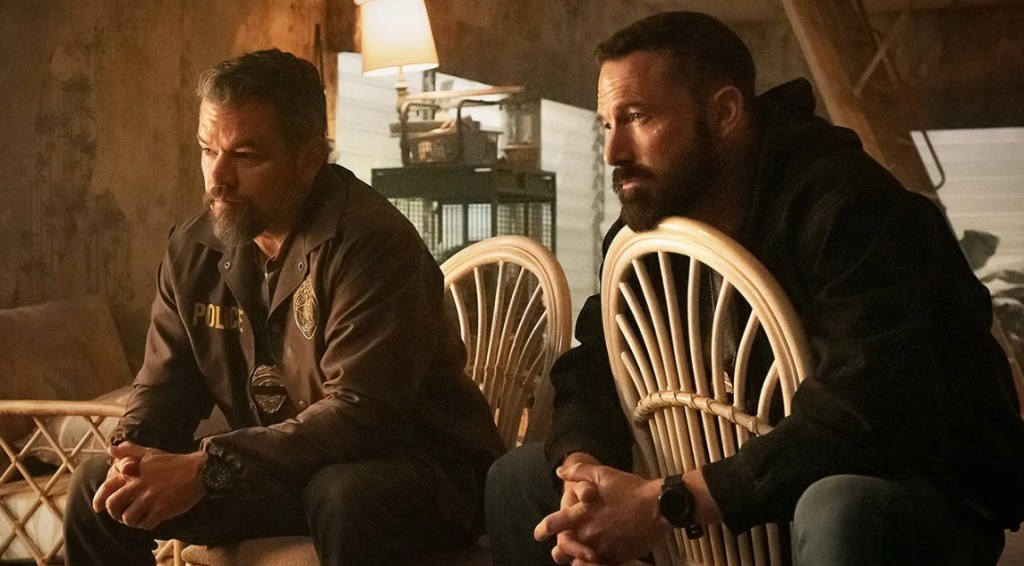
At the center is Detective Sgt. J.D. Byrne (Ben Affleck), still reeling from the recent murder of his captain, a woman with whom he’d been having an affair, and Lt. Dane Dumars (Matt Damon), his closest ally and the one most visibly rattled by the discovery of the money. As the night wears on, no one is quite sure who’s coming for them, who might already be compromised, or whether anyone in the house can be trusted. The tension isn’t driven by action so much as by suspicion: every sideways glance, every hesitation, every raised voice suggesting a hidden agenda. For a while, the film makes inspired use of its single location and uneasy alliances, with some pretty good foul-mouthed tough-guy dialogue that relates both macho camaraderie and simmering tensions.

In this stretch, director and writer Joe Carnahan seems to be working at the right scale — less bluster than he usually supplies in his noisy genre films, more atmosphere. Damon and Affleck, both playing edgier and more volatile than usual, sell the creeping dread remarkably well, and the supporting cast, including Kyle Chandler, Steven Yeun, and One Battle After Another‘s Teyana Taylor — adds texture, playing the genre beats well. The movie understands, at least initially, that the threat isn’t just the ghostlike gunmen potentially lurking outside but the knowledge that someone inside the house might decide to make a move.
Unfortunately, The Rip eventually falls into the same trap as Jan De Bont’s near-classic Speed — another film that peaks while its characters are trapped in a single, volatile situation and then noticeably loses steam once they’re freed from it. When Carnahan (who also wrote the film) releases his characters from the stash house, the movie trades impressive moral tension for sheer volume: endless machine-gun fire, extended car chases, and generic action mayhem that feels interchangeable with dozens (hundreds?) of other twenty-first century thrillers. The film plays its most interesting cards far too early, leaving another half hour to grind through material that plays louder but is much emptier dramatically.
This is where my longstanding resistance to Carnahan reasserts itself. Even his much-praised Narc always struck me as “’70s cinema playacting” — a film enamored of the idea of gritty filmmaking rather than achieving it. The Rip convinces you it might be something more disciplined, something genuinely sharp. Then the final forty minutes disabuse you of that notion.
Still, there’s no denying the cast’s commitment. Damon modulates his performance effectively in an environment that doesn’t welcome such subtlety, and Affleck’s hotheadedness is effective early on, when volatility is the point. And two-thirds of a very good film is obviously better than the full runtime of a bad one. If any of the elements of the film appeal to you, check it you, sure.
Ultimately, though, The Rip isn’t the big score it briefly promises to be. It mistakes escalation for momentum and noise and dramatic sleights-of-hand for payoff. What lingers isn’t the final barrage of bullets, but the memory of that early, uneasy stretch, when no one knew who to trust, the walls felt like they were closing in, and the film seemed poised to do something genuinely sharp with its setup.
-30-



 Tremble...Sigh...Wonder...
Leave a comment