
by James Kenney
Considering the thrashing it’s received from critics — largely those who got to see it for free — I found Scott Cooper’s Springsteen: Deliver Me From Nowhere quite reasonable, and this is from someone who spent eighty bucks to bring his family and buy some snacks. I certainly didn’t feel ripped off. It doesn’t feel like a rock‐star redemption spectacle — far from it — but it offers a steady, grounded portrait of the moment when Bruce Springsteen turned inward rather than outward when making the acoustic low-fi album Nebraska instead of chasing hits. I approached the film with expectations softened by the noise around it and found myself willing to ride along in its slower lane.
I was born just in time to ride the Born in the U.S.A. flaming train of success as a happy teenage passanger, and thus knew Springsteen only as a star. Nebraska (1982) to me was simply a celebrated album, a total success that cemented his legend, not the radical left turn it apparently represented in his life and career upon its release. The label, riding high on the momentum of the double album The River and a monster hit in “Hungry Heart,” was anticipating a follow-up with more radio hits and stadium thunder. Instead, Springsteen, driven by private demons and triggered by a viewing of Badlands (Terence Malick’s stark chronicle of Charles Starkweather’s killing spree across Nebraska), retreats to a rented house and records the album in the bedroom on sub-standard equipment. The making of that album, his interaction with loyal friends (especially manager Jon Landau), and a romance with a single Jersey mom who seems more an ideal-figure for Springsteen than long-term partner — these are the elements at the core of the film.
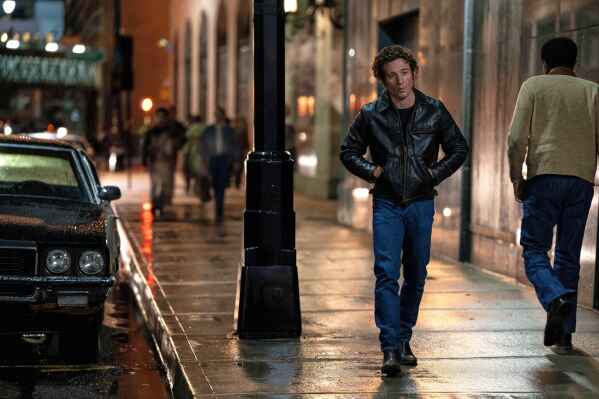
No doubt green-lit because of the sizeable success of A Complete Unknown (James Mangold’s Dylan biopic), Deliver Me From Nowhere is almost an inversion of that film: Dylan goes electric, up-ending his folk audience, allowing for a rousing finish at Newport. This film is about Springsteen going low-tech, writing songs about homicidal maniacs, tortured fathers and Jersey crime, so it isn’t pre-built to offer toe-tapping hits like Mangold’s film. Indeed, instead of rock ’n’ roll fireworks, the film glows with the faint red light of a reel-to-reel recorder — a subdued portrait of creation and self-interrogation rather than performance.
The film is a bit of a trick on the audience: it isn’t really about the making of Nebraska, as though the turning in of the tapes were the closing chapter. Rather, once the album is complete the film keeps going — it’s about Springsteen making the album as an attempt to fight the depression he wasn’t even admitting he had, and then about depression absorbing him when finishing the album doesn’t expel it. So, surprisingly and challengingly, the film carries on another half hour past what feels like its natural end — a final stretch in which no new songs play until a live version of “Atlantic City” plays over the ending credits. This ambition is commendable though not wholly successful. A series of one-on-one scenes where Springsteen both succumbs to and fights his depression work only intermittently. And as the film winds down, showing him coming off stage after a successful arena show — well, it might have been a good idea to show him in concert, having rediscovered his love for performance, doing “Cover Me,” since the song is brought up several times in the film without payoff. We’re told he wrote it for Donna Summer, then told he held it back for himself because it was too good — and then it vanishes from discussion. Why, I wonder, doesn’t the A.I. software everyone is no doubt using to evaluate scripts spot obvious script payoffs like I, all-too-human, do? A rousing “Cover Me” at the end would’ve worked!
The performances are strong. Jeremy Allen White plays Springsteen and does a solid job. He’s only allowed to portray a largely dour Springsteen: it works and doesn’t feel false but having seen enough historical footage of Springsteen — even when he was younger and a bit more monosyllabic than his 21st-century self — he still seemed quick with a witty, tossed-off line. Here he’s monosyllabic but largely lacking wit. The entire cast holds up, though Grace Gummer, who plays Barbara Landau (the wife of Jon Landau, portrayed by Jeremy Strong), struggles in her brief scenes: the depiction of the Landau marriage hardly feels lived-in. She is essentially there to hear Landau voice concerns about Springsteen, and then to offer support that feels humorless and mechanical.
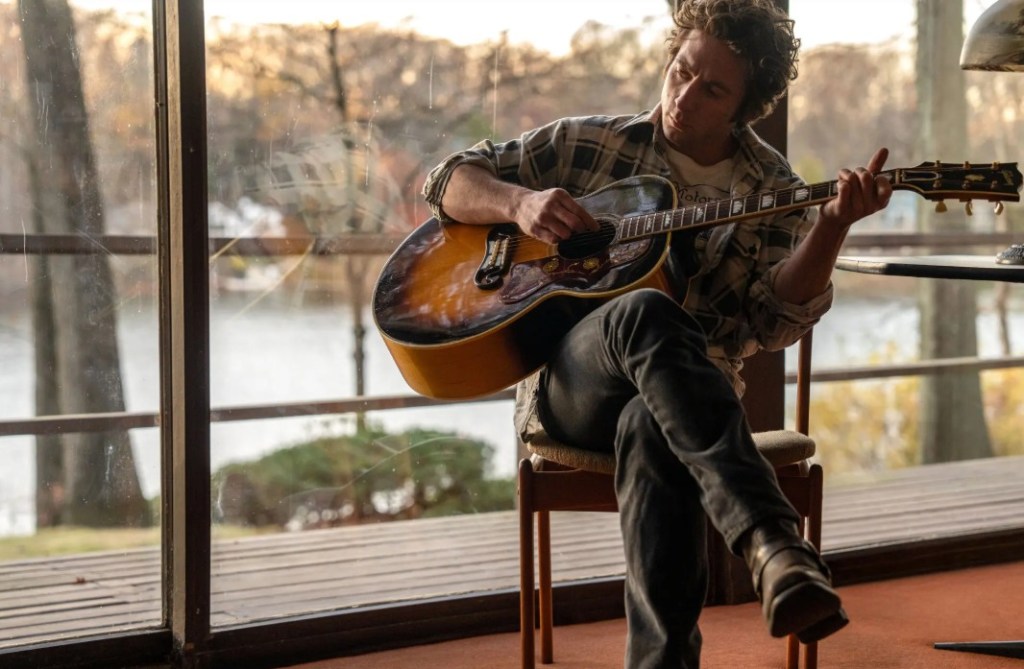
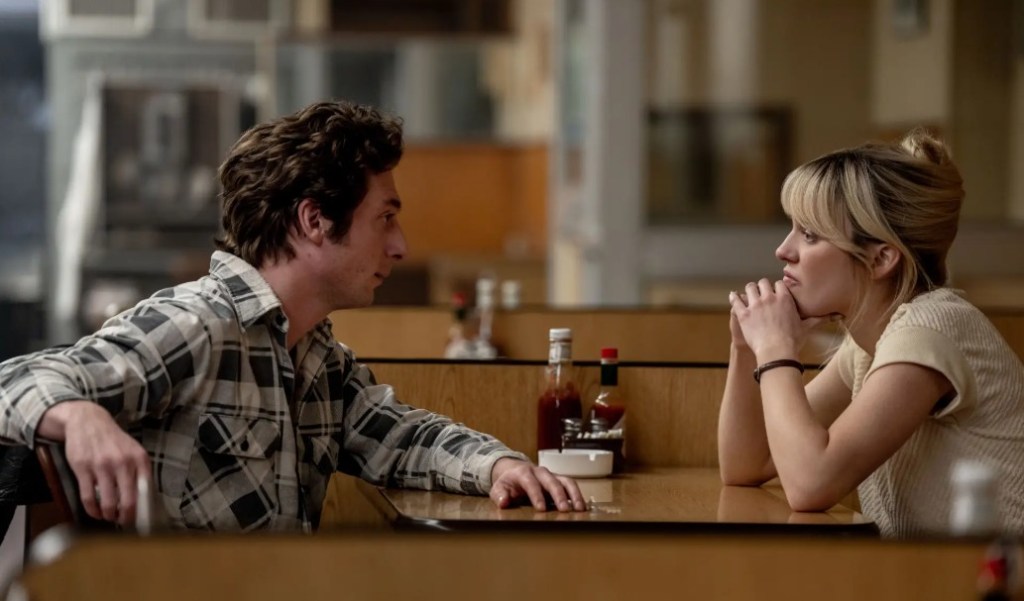
And then there’s the score by Jeremiah Fraites. It is, frankly, quite irritating in its middling competence. Scoring a film already saturated with superior Springsteen music with bland, synthesized piano cues that could underscore a Hallmark television reunion scene is like painting over weathered wood with plastic gloss, erasing the texture you came to feel. As a longtime admirer of Peter Bogdanovich, I’d remind filmmakers that a largely diegetic soundtrack can be the braver choice. When Odessa Young’s character sits alone in a diner, tears gathering as she tries to hold herself together, imagine if we heard only the eggs frying, the glasses clinking, the low hum of other people’s chatter — the small, ordinary music of a world that keeps going. That would carry more truth than another “sad piano” motif insisting we feel something the moment already earns. When you have Springsteen’s catalogue to draw from, you don’t need to gild the ache.
But having not “been there” for Nebraska — I was there from 1984 on, beginning with Born in the U.S.A. — I found the film compelling, the story interesting, and the Jersey milieu nicely realized. It’s not as inspired as A Complete Unknown and is perhaps a shade too self-serious, but it is no disaster. I’m glad I saw it, and several family members who aren’t slavish Springsteen fans quite enjoyed it. So, I suspect this is one hostile social-media wave I’ll take on by myself.
Springsteen: Deliver Me from Nowhere doesn’t wholly ignite, but in chronicling the making of Nebraska and the shadow of depression, its steady pilot light feels right — the measured burn of an artist holding off the dark as long as he can. Check it out for yourself and curse me afterward if you must.


 Tremble...Sigh...Wonder...
Leave a comment