By James Kenney
Paul Thomas Anderson’s One Battle After Another crackles with revolutionary zeal and gallows humor — a vision of chaos so alive it feels combustible — violent, outrageous, and impossible to look away from. It’s a comedy of chaos and conviction that somehow never loses its grip on suspense, a satire so tightly wound you find yourself laughing and flinching in the same breath. The film manages a rare balancing act: it’s funny without deflating its own tension, sharp without turning smug. The result is a scorched, sand-blown entertainment about the absurd theater of extremism —a movie that turns both fierce conviction and moral collapse into facets of the same tragicomedy, without ever letting you feel entirely safe in your laughter.

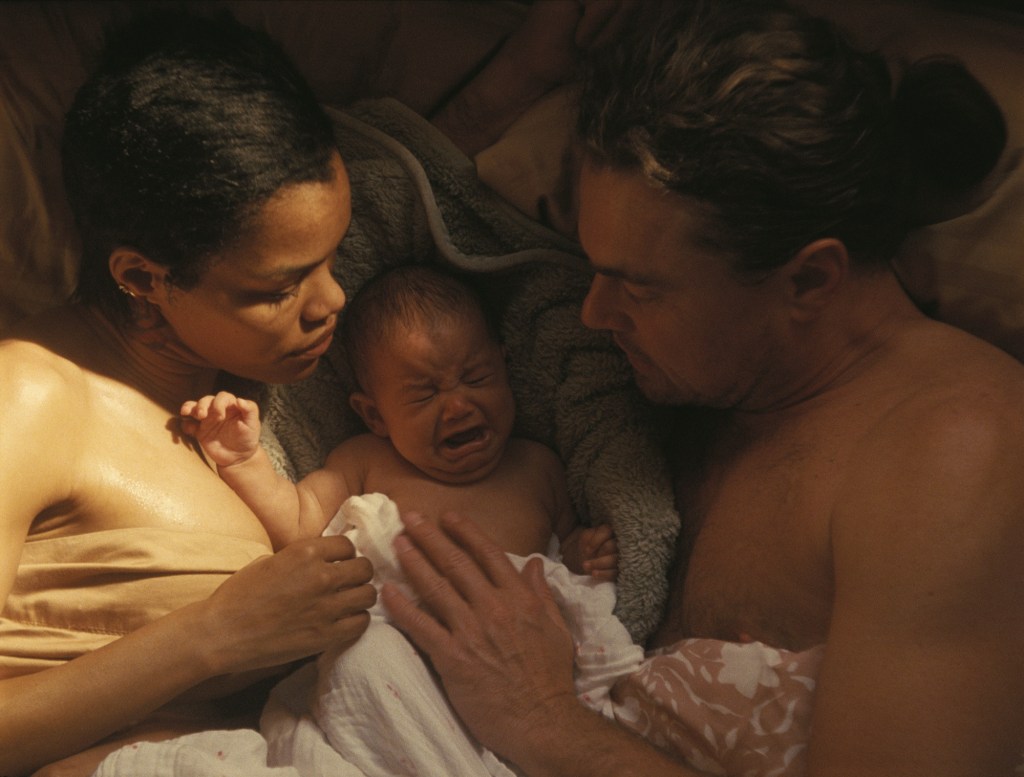
Leonardo DiCaprio is one of those guys you increasingly want to hate the minute he’s photographed with a telephoto lens on a yacht — his belly hanging out, 22-year-old Brazilian model in tow — not because she’s young (maybe she just doesn’t want to date a 22-year-old Young Republican incel with no money or charm), but because he seems to be enjoying the run of life a little too much. He seems the sort of guy who’ll produce a documentary on climate change and then fly a private jet from the Maldives to some rugged Arctic archipelago like Blåfjellbreen to premiere it, with black-tie penguins serving espresso martinis. Yet for all my easy mockery, he’s wholly compelling — powerful, oddly vulnerable playing a character who’s like a cracked compass that still points True North when it matters. In One Battle After Another he’s grizzled, forgetful, a little burned out — the kind of guy with “brownout problems” and too many lost passwords — but when his daughter is abducted, the haze clears. His messy intensity carries the film’s moral weight almost in spite of itself.
Anderson takes chances. His villains have a grand, grotesquely self-pleased sweep to them — white supremacists calling themselves the Christmas Adventurers, secretly running the world. Those complaining that the film “romanticizes domestic terrorists” seem to miss the point: Anderson isn’t endorsing extremism so much as reflecting it back at a country that’s already knee-deep in its own, thank you very not. The rise of openly racist, fascist streaks within the Young Republican set only reinforces his near-Illuminati vision of America — a nation where conspiracy and power have become indistinguishable. The movie’s funny but it isn’t. The Christmas Adventurers ARE the domestic terrorists, and those who don’t see that have already failed the big test.

Sean Penn disappears into his characters so completely that even when he turns up in something minor like Mel Gibson’s The Professor and the Madman—a film that went straight to video—he drags it into another emotional register entirely. In One Battle After Another, he does the same but on a darker, more corrosive scale. As the cynical MAGA soldier who’s turned his private grievances into a career, Penn plays a man whose only compass is self-interest—manipulating government agencies, lying through his teeth, and murdering his way toward a corner office in the “Christmas Adventurers” compound. He’s disgusting, chilling, comic, pitiful, and wounded all at once: the kind of man who turns his repressed sexual desire for Black skin into a campaign of violence. It’s a shocking, unguarded performance, fearless in its ugliness and entirely devoid of vanity—the work of an actor who still believes in disappearing completely, even into monsters.

Teyana Taylor delivers one of the film’s most audacious conceits, embodying a woman who seems to stand above the rest — confident, commanding, unflinching — yet proves arguably the weakest character of all because her supposed strength is rooted in cynicism and moral fracture. Perfidia Beverly Hills, as she’s named herself, begins as the revolutionary with the upper hand: she’s sure of her mission, sure of her enemies, sure of her body and its power. But as the story unfolds she destroys those closest to her — fellow revolutionaries and even her own family — not because she lacks will, but because she mis-uses it: manipulating, betraying, leaving destruction in the name of her idea of being “free”. The film invites you to read her as the one who had it all together, only to show she didn’t; and then arguably wants to forgive her at the end for what seems pretty unforgivable. Throughout, characters — good and bad alike — are increasingly alert to her danger and her fundamentally unreliable nature, and Taylor makes that dual role riveting: she is magnetic when she leads, frightening when she descends, wounded when she falters. It’s a bravura turn that confirms her as a performer of rare depth (who I was wholly unaware of, going in).

Benicio Del Toro plays the one man in the film who seems genuinely comfortable with the chaos. Born Latino—which means he’s marked, and let’s not pretend they aren’t, the sizable Latino vote for Trump only proving how thoroughly confused (and fucked) reality is—he’s lived long enough with absurdity to make peace with it. Where Di Caprio’s revolutionary is jittery, neurotic, forever second-guessing what to do next, Del Toro moves through the madness like a man who already expects the world to collapse and knows there’s no point wasting energy on surprise. If Di Caprio falls off a roof and gets arrested, Del Toro just sighs, lights a cigarette, and figures out what needs doing next. He represents the film’s funniest, most humane note—the revolutionaries who accept life’s ridiculous unfairness with good humor and still fight it with everything they’ve got. In one of Anderson’s great sequences, the skateboarders helping Di Caprio escape across the rooftops keep breaking into tricks mid-chase, laughing as they risk their lives; it’s like the only sane response to apocalypse is style.

Chase Infiniti bursts into the film halfway through as Willa, and watching her you understand immediately why her presence matters — she’s the revelation this sprawling epic needs, and justifies the need for revolution. With eyes that speak volumes and a quiet, unforced magnetism, she embodies something both fragile and fierce: a beautiful biracial teenager who stands for possibility in a world the “Christmas Adventurers” dread. Although she appears later, you don’t ever feel that the long runtime is a burden — when Infiniti arrives, it’s like watching a double-feature where the second film proves just as compelling as the first. Infinity grounds the narrative’s chaos with her stillness, her awareness, her pulse of impending change. And as she steps into the fierce logic of her parents’ revolution — the one they began, the one she’s now inheriting — she gives the film its pulse again, reminding us that idealism can still move like fire through the ruin.

Jonny Greenwood’s score is a little too insistent for my taste at certain moments, and some plot points don’t quite add up in the end, logically. But, so what? One Battle After Another feels like a fevered broadcast beamed from a country in the middle of eating itself — hilarious, profane, and uncomfortably honest. I’m no Anderson apologist; he’s a great director, but Inherent Vice frankly bores me, for example, its broad comedy (Martin Short, for example) unfunny and a flat-out mistake. But here, Anderson spins moral confusion, political farce, and personal ruin into something that feels both inevitable and freshly imagined. The film lurches between tones and tempers but never loses its pulse; every performance seems to exist on the edge of collapse, which is exactly where Anderson wants them. It’s a darkly funny, deeply unnerving epic that stares straight into our modern madness and somehow finds rhythm in it — like a broken radio still managing to play beautiful truth despite increasing static.



 Tremble...Sigh...Wonder...
Leave a comment