
By James Kenney
April, 2025
Out of the Darkness, Into The Evening
When Marshall Crenshaw dropped Good Evening in 1989, his final album for Warner Bros. records, it felt like the last stop on a bumpy ride that didn’t exactly scream “career milestone.” It had all the hallmarks of a contractual afterthought—thrown together to quietly fulfill obligations and then fade into the sunset, ideally without anyone making a fuss.

Good Evening followed a remarkable streak of four indelible masterpieces—his indefatigable self-titled 1982 debut; the bold and misunderstood Field Day (1983), all thunderous drums and sonic daring; the soulful, roots-rock odyssey Downtown (1985); and the lush, dreamlike beauty of 1987’s Mary Jean & 9 Others. The previous albums received rave reviews but were proving increasingly marginal commercially, and Good Evening wasn’t a big comeback moment or a passionate reinvention. Never mind label indifference; Crenshaw himself didn’t seem all that hyped about it, either. As he put it in 1991 while promoting his next album (for a different label), Life’s Too Short: “I wasn’t writing many songs back then. I didn’t want to write any songs for [Good Evening], because I had very little faith and I couldn’t get myself to make that kind of commitment to the record.” That’s about as far from “I poured my soul into this” as you can get.

That should’ve been the end of the story.
And yet… here we are. Good Evening has aged like one of those great albums you somehow missed, tucked away in a dusty corner of a good friend’s record shelf. It’s a low-key, wonderful marvel, half covers, half collabs, all killer. Village Voice reviewer Robert Christgau nailed it back in ’89 when he noted “not since the debut has [Crenshaw] sounded so at ease, so himself.” Listening now, it plays like the great lost Crenshaw record: warm, sharp, effortless, and just a bit heartbroken. Somehow, even in his ambivalence, Crenshaw conjured up an album that hums with clarity, warmth, and bite –a record that was unleashed upon the world as no more than a weary sigh, but lands like a kiss on the cheek. Good Evening doesn’t beg for your attention so much as earn it, song by song.
A Band on Fire, A Frontman in Doubt
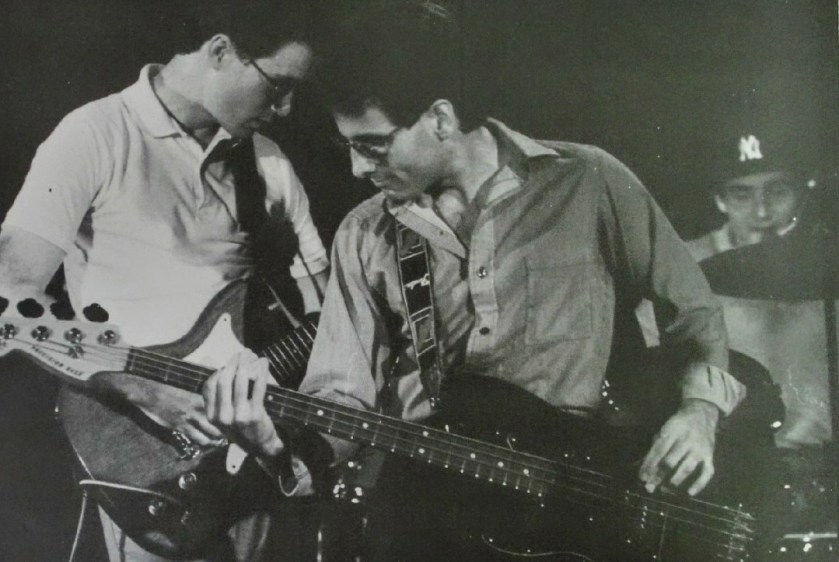
One of the album’s secret weapons? The players.
Crenshaw’s earlier band lineups were legendary—his brother Robert on drums, Chris Donato and later Graham Maby on bass, but Crenshaw assembled a dream team for the Good Evening sessions:
- Kenny Aronoff, fresh off his work with John Mellencamp, gives the drums serious backbone.
- Graham Maby, Crenshaw’s bassist on Mary Jean and Joe Jackson’s right-hand man, returns with melodic flair.
- Sonny Landreth, slide guitar sorcerer, adds haunting textures throughout.
They’re tight, professional, and on fire. And that’s what gives the album its curious charm: while Crenshaw may have felt detached, the band was absolutely locked in. That contrast—the artist unsure, the musicians inspired—gives the album an emotional undercurrent that’s hard to fake. It’s as if Marshall walked in lukewarm and the band collectively said, “Don’t worry, boss—we got this.”
And they really did. The performances, including his own vocals and guitar-work, are wired with energy. The band elevates everything, like they’re willing the album into being something more than just an end-of-contract shrug. This friction—between Crenshaw’s malaise and the band’s fire—gives Good Evening its strange, undeniable pulse.
Songs That Hit Different (Even When They’re Not His)
The opener “You Should’ve Been There,” co-written with Leroy Preston (of Asleep at the Wheel fame), kicks the door down with confidence. It’s classic Crenshaw heartbreak, uptempo yet bittersweet, and sonically pristine. “I saved you a place right by my side… but the only friend I had in sight was an empty chair”; That’s not just a lyric; it’s a call to melancholy arms. The vocal layering harks back to his debut, all self-harmonies and clarity, and the production has that late-night shimmer that makes it feel personal, like a postcard written in candlelight. It’s one of those songs where regret is baked into every line, and the harmonies sneak up on you like an old friend who’s got bad news. It feels like a breakup song aimed at the fans who ghosted the incredible Mary Jean & 9 Others.
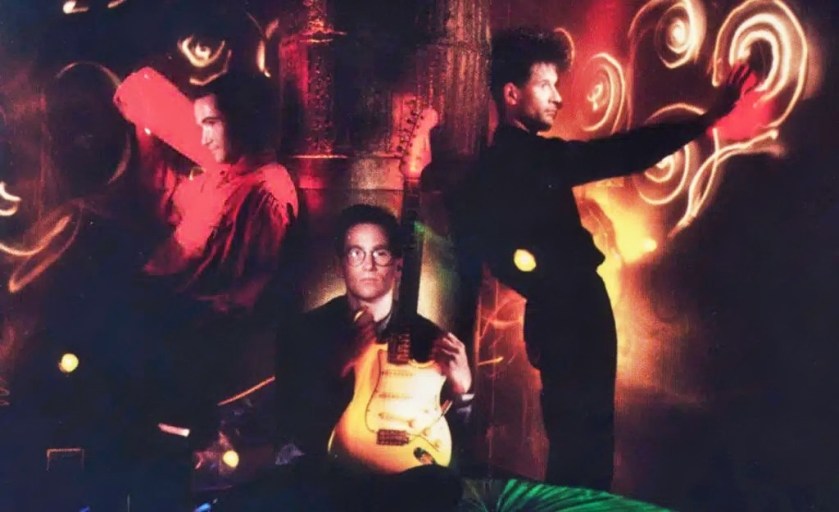
Then there’s a Richard Thompson cover, “Valerie,” which Crenshaw absolutely owns. He takes Thompson’s sardonic edge and turns it into a breathless, semi-hilarious lament of romantic chaos. “I’m soft in the head, I give her hard cash…” It’s a guy unraveling but trying to (make us) laugh through it. Aronoff’s drums are locked in, and Crenshaw sells every line as the victim who nevertheless can’t stop himself from writing the checks.
His version of John Hiatt’s sardonic lament “Someplace Where Love Can’t Find Me” is the flip side of the same coin, Crenshaw turning it into an oddball anthem and the album’s emotional peak. Landreth’s slide guitar weeps like a drunk on the verge of a breakthrough, while Crenshaw sings like a man who’s trying to outrun his own heart. When he insists “I don’t have another love in me / Can’t even let the last one go,” you believe him. The song’s half prayer, half primal scream.
Crenshaw’s feral cover of the Isley Brothers’ “Live It Up” is pure forward motion—a jolt of nervous energy masquerading as celebration. It’s not just a party track; it’s a dare. You can almost hear Marshall trying to will himself into joy, repeating the title like a mantra against the creeping doubt that shadows much of the record. But here’s the thing: he pulls it off. The guitar work is searing, slicing through the track with urgency and bite, while the rhythm section barrels forward with all the restraint of a runaway train. There’s nothing laid-back about this one. It’s sweaty, snarling, and alive. In a weird way, it’s one of the most honest tracks on the album: an artist telling himself to keep going, and making damn sure the music sounds like he means it.
The Art of the Gentle Rework
Crenshaw does this thing, see, he changes the emotional weather of a covered song. He can take songs that feel jagged or ironic and wrap them in something inviting without losing their sting. It’s the same trick Springsteen and Rod Stewart pulled when they covered Tom Waits. Crenshaw finds the sweetness hidden in songs by choleric guys like Thompson and Hiatt and pulls it out gently, like a splinter with soul. It’s the same song, but the soul shifts.
Deep Cuts and Radio Dreams
“She Hates to Go Home,” another Crenshaw/Preston original, might be the sneakiest gut-punch here. It’s so gentle you might miss how sad it is. The arrangement is subtle, just enough to carry the ache, but Crenshaw’s vocal hits like a well-meaning guy genuinely worried that he can’t reach a woman in desperate need. His crystal-clear acoustic solo is beautifully bare, like a private thought whispered into the mix. It’s a lullaby for the lonely, a song about someone afraid to sit in silence with her own thoughts. Gorgeous stuff.
And “Radio Girl”? That’s just pure vibe. A late-night slow burner co-written with the BoDeans guys (Kurt Neumann and Sam Llanas), it starts with a fade-in, like you’re accidentally walking into a room at 3 a.m., mid-jam. The lyrics are playful and just a little tragic—he’s in love with a faceless DJ; someone who plays James Brown records and eases him through his long night. It’s low-key obsession as love song– all about connection through static and song requests. The line “She rocks away my blues” is pure Crenshaw, funny, sweet, and kind of heartbreaking, and maybe some of us wanna hang out with the guy who believes that hard in someone he’s never met. The Springsteen who wrote “Radio Nowhere” gets it.
How Marshall Crenshaw Came To Cut a Diane Warren Song.
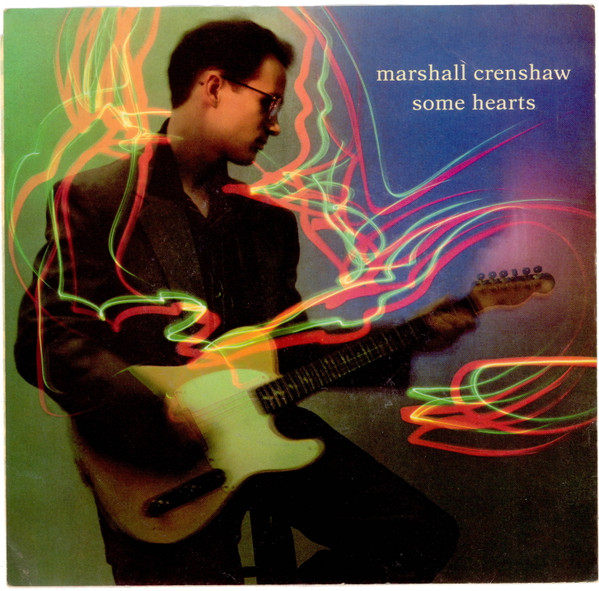
Yes, Marshall Crenshaw’s “Some Hearts” is that song—the one Carrie Underwood took to the bank on her debut album, written by Diane Warren, known for writing nine number one and thirty-three top ten hits (so far) for the likes of Celine Dion, Leanna Rimes, Toni Braxton and Aerosmith (“I Don’t Want to Miss a Thing”). But Crenshaw cut “Hearts” first. Interesting story.
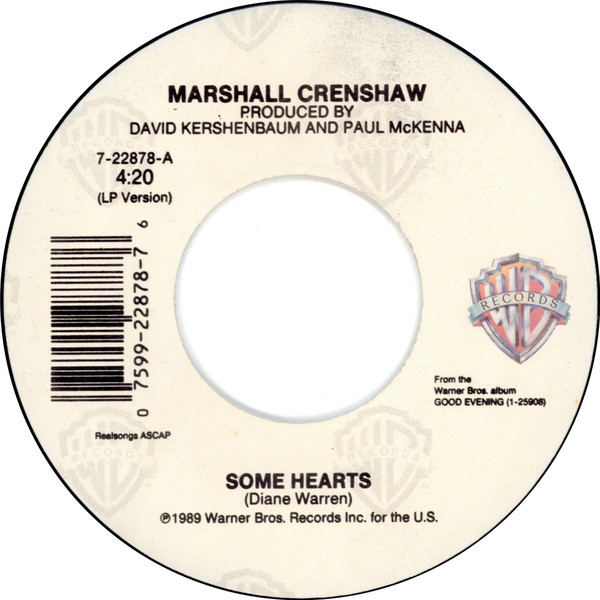
You might think the label pushed for it, given Warren’s storied history of writing massive hit singles as a writer-for-hire (which had begun half a decade before Good Evening with De Barge’s “Rhythm of the Night”), but that’s not the case. Kenny Aranoff actually brought the song to Crenshaw’s attention, and he cut it, but not before Crenshawizing Warren’s radio-ready ballad into a hillbilly rave-up with help from David Lindley and his cosmic fiddle, and changing a few of the lyrics, turning a potential hit into a twangy hillbilly detour. “We sabotaged it,” Crenshaw later said. And the schism at Warner Bros. was such that as Crenshaw told me via email “my beloved NY A&R person, Karin Berg, was mortified when she heard the track and really got on my case about recording it- it was offensive to her…I didn’t know who Diane Warren was, but Karin did and was most certainly not a fan. She completely balked when she heard that track. Of course, it got the opposite reaction in Burbank, and they released it as a single- that schism between the East Coast’s reaction and the West Coast’s reaction pretty well sums up my whole experience at Warner Bros.”
And yet, it’s… good. Really good. Weird, yes. But heartfelt and singular in a way most Diane Warren tracks aren’t. Maybe because Crenshaw’s version doesn’t chase radio perfection. It feels weird, honest, and totally his. Underwood later took it to the top of the charts in 2005, but Crenshaw made it strange and beautiful first.
Three More Tracks Worth Falling in Love With
“Whatever Way the Wind Blows”: The Hit That Wasn’t (Yet)
Then there’s “Whatever Way the Wind Blows,” a sunny, country-inflected charmer Crenshaw original. It probably wasn’t exactly the radio smash Warner Bros. hoped Crenshaw would deliver back in ’89 to counter Bon Jovi and Taylor Dayne, but Marshall had the last laugh: country artist Kelly Willis turned it into a minor chart and video hit just a few years later. Crenshaw’s original take is breezy, buoyant, and effortlessly catchy—a sweet, slightly-twangy ode to going with the flow of love’s uncertainties. It’s a song made for car rides, windows down, radio up—at least in Nashville. The label might’ve missed its hit potential, but time proved Marshall right yet again.
“On the Run”: Rocking Away from the Past
Next, we have “On the Run,” a taut, nervy rocker that Crenshaw originally penned for the short-lived 1987 TV series Private Eye. Here, the song feels distinctly autobiographical, mirroring Crenshaw’s own restless desire to break free from his increasingly strained relationship with Warner Bros. Records. It’s all jittery rhythms and anxious energy, capturing that precise moment of looking over your shoulder, desperate to escape. The song practically vibrates with pent-up frustration, but also determination, as if Marshall’s already seeing clear roads ahead. As a snapshot of an artist itching for change, it’s both compelling and revealing, capturing Marshall right on the edge of something new.
“Let Her Dance”: Closing Out with Pure Joy
Closing out the album is Marshall’s vibrant, irrepressible cover of Bobby Fuller’s classic “Let Her Dance”—and what a way to say goodnight to Good Evening. It’s a track that starts strong and only picks up steam as it barrels forward, building with an unstoppable momentum. Crenshaw and the band throw themselves into it like they’re racing against time, layering on harmonies, jangly guitars, and relentless rhythmic energy until the song feels as big and joyful as anything in his catalog. It’s exactly the kind of send-off you want from an album that often dwells in quiet melancholy: a final, joyful reminder that even if love is gone, the music can still soar.
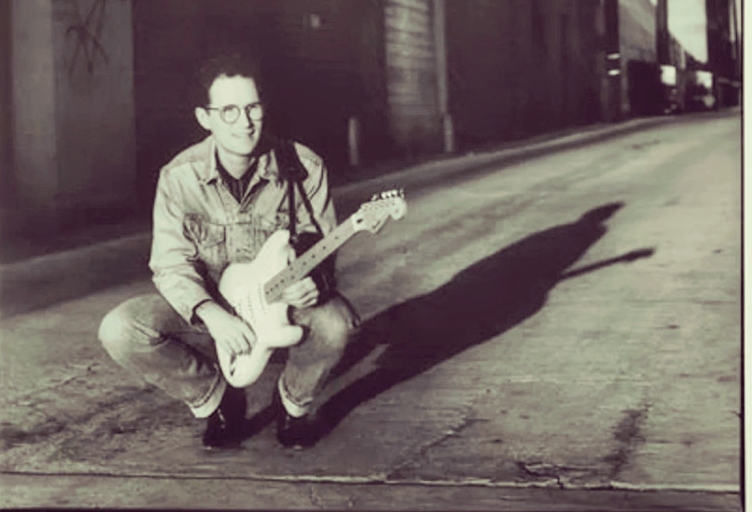
Unearthing a Lost Gem: “Honest Heart”
Here’s where the story gets personal. I am the world’s greatest Good Evening fan, in love with Crenshaw since I first heard “Someday, Someway” as a wee lad in 1982, and Good Evening was one of the first two compact discs I ever bought (the other being Living Colour’s debut).
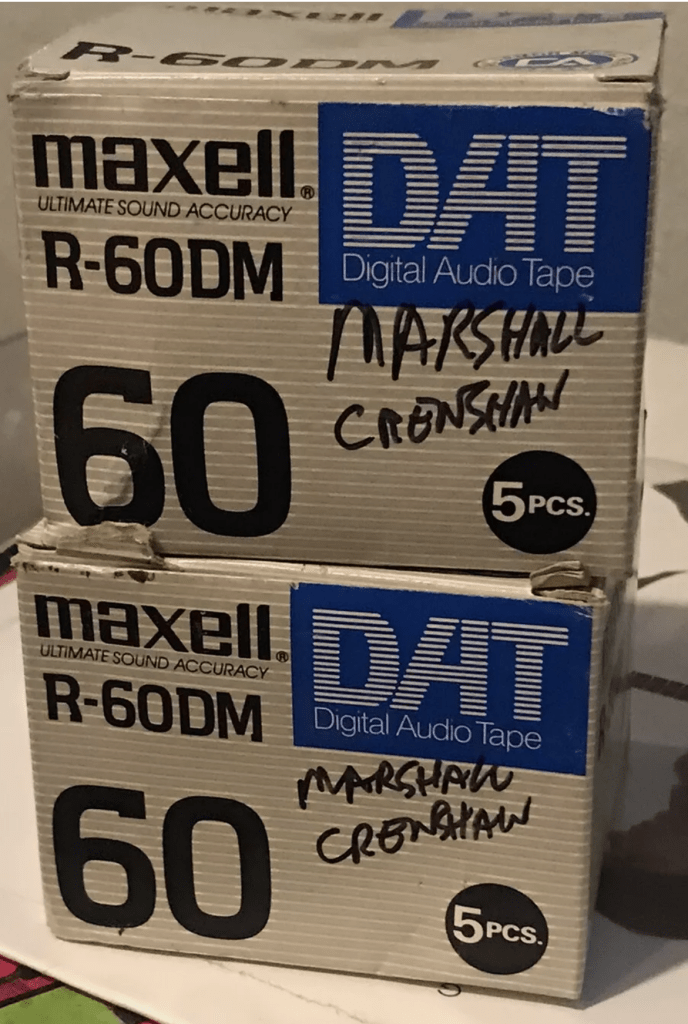
Late last year, I stumbled on a bunch of Good Evening DAT tapes on eBay (as one does, and as I did for an entire lost Peter Bogdanovich film I helped get released) and unearthed a stash of alternate mixes, instrumental takes, etc. from the Good Evening sessions—including an unreleased Crenshaw original called “Honest Heart.” It’s got that Byrds-like shimmer, all chiming guitars and classic MC melodies. When I asked Crenshaw about it, he couldn’t even remember recording it or why it didn’t make the cut. That’s how lost this treasure is. But there it is—a lost piece of a nearly forgotten record by an absolute musical legend, waiting for rediscovery. There is a God, and she’s a Crenshaw fan who willed me to track down these DAT tapes and convert them. I want Crenshaw to have full say about when and how the song is officially released, so allow me to share a decent-sized excerpt for the committed faithful who have come this far and are starving for “new” Crenshaw:
HERE IS A LINK TO AN EXCERPT OF AN UNRELEASED MARSHALL CRENSHAW SONG FROM THE GOOD EVENING SESSIONS: “HONEST HEART!”
Time for a Proper Encore
With Crenshaw now reclaiming his Warner Bros. catalog and reissuing his early records through Yep Roc, it’s high time Good Evening got the deluxe treatment. Remastered tracks. Alternate takes. A proper spotlight. It may not have charted or gotten its moment back in the day, but the music’s still here—sometimes rowdy, sometimes lovely, and waiting to be found. Good Evening isn’t just an underrated record, it’s the kind of album you carry in your heart once you find it. It’s a love letter slipped into a book, only to be forgotten. A perfect song stuck on an B-side. A man, a band, a moment in time that got overlooked—but now, maybe, gets to step back into the light.
Good Evening isn’t flashy. It doesn’t shout. But it listens back. It lingers. It’s the sound of a songwriter in temporary retreat and a band still charging ahead. And in that tension, there’s a quiet kind of magic.
As the Bard warned, “If once it be neglected, ten to one / We shall not find like opportunity.” And that’s the thing about Good Evening: it was neglected. But the opportunity’s right here, right now. We’ve got the tapes. We’ve got “Honest Heart.” Marshall’s got the album rights. We just need someone to hit play.
-30-




 Tremble...Sigh...Wonder...
Leave a comment