
by James Kenney
Catching up this year with Antonia Bogdanovich’s Sleep No More, a reimagined director’s cut of her 2014 debut Phantom Halo, was an unanticipated, lovely surprise. The gifted Bogdanovich has taken up the mantle of her unquestionably brilliant father’s proclivity for fiddling with unsatisfying previous cuts (Last Picture Show, At Long Last Love, Nickelodeon, They All Laughed, Mask, Texasville, The Thing Called Love, and of course She’s Funny That Way/Squirrels to the Nuts all have multiple versions where Bogdanovich addresses injustices major and minor bestowed on him by outside forces).
This seems strangely right, as the film observes damaged children whose lives are defined by a brilliant but flawed and self-involved father whose personality fills any room he’s in. While undoubtedly written as a dramatic crime-film exaggeration of Bogdanovich himself, the film’s chief antagonist is clearly drawn from Antonia Bogdanovich’s personal experience growing up in L.A. in the shadow of a flawed, mesmerizing giant, and is all the richer for it.
Co-written by Anne Heffron, Sleep No More emerges as a compelling, unconventional neo-noir crime comedy-drama that knottily weaves Shakespearean motifs with the contemporary despairs of Los Angeles-living where all relationships are transactional, all and sundry are looking for an angle, and everyone is reimagining themselves while carrying a secreted story they’re terrified to reveal. There are some glitches towards the end as Bogdanovich works to loosen the laudable dramatic knot she’s created in the first two thirds. Nevertheless, the picture not only showcases Bogdanovich’s nascent directorial ability but also offers a poignant family dynamic at its center that disconcertingly echoes her own familial experiences.
Narrative and Thematic Depth
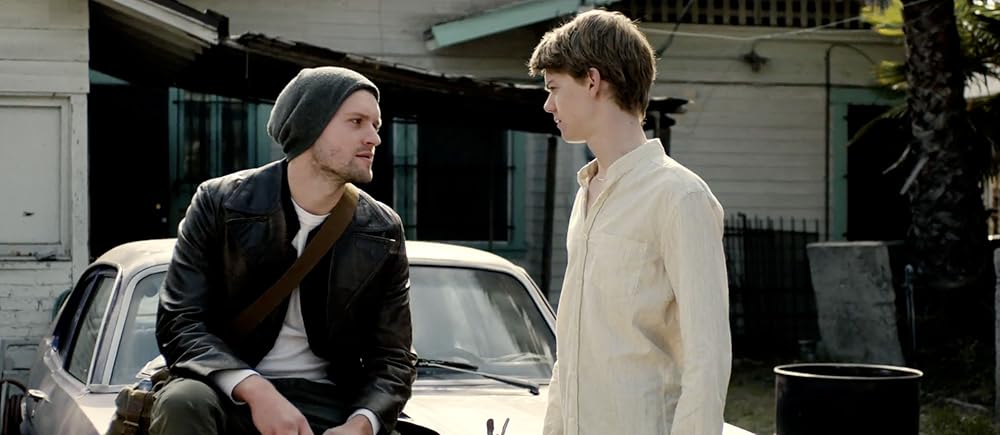
“Sleep No More” centers on a dysfunctional family of screwups, the Emersons, led by Warren (Sebastian Roché), a once-renowned Shakespearean actor now ensnared by alcoholism and gambling, but who nevertheless is convinced he holds all the answers in life. His sons, Beckett (Luke Kleintank) and Samuel (Thomas Brodie-Sangster), navigate day-to-day survival through street performances and petty crimes. Samuel captivates passersby on Santa Monica’s 3rd Street Promenade with ardent Shakespearean monologues, while Beckett adroitly pickpockets the entranced audience.
These characters could easily be the center of a rich, eccentric comedy, and the film does see the humor in the situation, but their precarious existence is further jeopardized when Warren’s debts to a menacing loan shark, Roman (Gbenga Akinnagbe), escalate, propelling Samuel into a risky counterfeit money scheme and an eccentric romance with the mother of a fellow counterfeiter (Femme Fatale‘s Rebecca Romijn, solid in a part that could have slipped into camp, a good marker of Bogdanovich’s sensitive handling of the actors).
Autobiographical Undertones
The film’s narrative bears compelling likeness to elements of Bogdanovich’s upbringing, as she has pointed out in interviews connected to last year’s Sleep release. As the daughter of esteemed filmmakers Peter Bogdanovich and Polly Platt, Bogdanovich was immersed in a world where art and personal tumult often intersected. Reflecting on her childhood, she explained to Moveable Feast, “From a public point of view, my family seemed great and idyllic, but there was divorce, murder, death, cheating, lies—there was just a lot going on, even though my parents loved me and I loved them.” This intimate understanding of the performative world pervades the film, adding layers of authenticity to the characters’ struggles and aspirations. As Bogdanovich added, “Metaphorically speaking, I think if you have parents that have done great things that you respect and honor and learn from, you have to eventually get them out of your head and you have to become your own unique individual, so [I realized] maybe that’s why I had to make this movie.”
In an interview with U.K. Film Review, Bogdanovich stated “I remember when I was really young and had told my father I wanted to be a writer, he said that all the plots had already been written by Shakespeare and so my focus should be on creating interesting characters and how they navigate through the story.” The film follows through on this sage advice, with each new character we become acquainted with an offbeat variation on an archetype; we’ve seen alcoholic, deadbeat dads before, but not ones preoccupied with the beauty of Shakespearean verse. We’ve seen femme fatales before (Romijn herself played one for De Palma!) but Bogdanovich’s variation proves arguably the kindest, most sensitive character in the film. Sleep is filled with deft character touches that glance off your elbow; they’re not rammed down your throat.
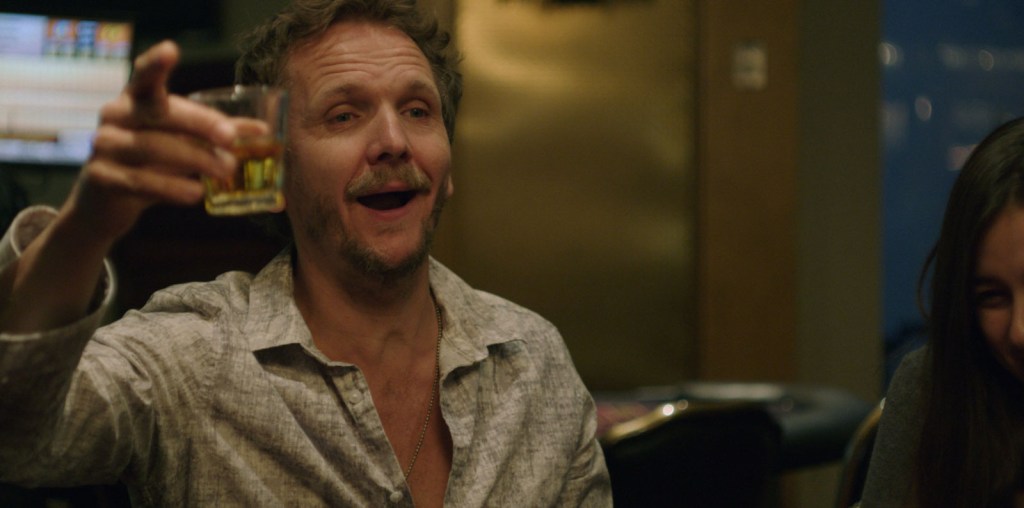
Warren Emerson is posited by Bogdanovich as being directly inspired by her father in her UK Review interview: “Even though the patriarch is a hopeless gambler and alcoholic, who puts his entire family in jeopardy, he won’t tolerate bad grammar, comic books or state-mandated education. He lives in a fantasy world of Shakespeare and conducts himself like one or several of the Bard’s characters.”
She relates how despite the many financial and social complications that befell her family, her father also made sure the family only watched great films — no television! — at home. As Bogdanovich explains, for her dad “Cinema was the Word” much as Shakespeare is the Word for Warren, forbidding his son the joys to be found from his beloved Phantom Halo comic book. For the educated film fans who come to Sleep with this knowledge, it adds an irrefutably fascinating layer to the Warren character, as does Antonia Bogdanovich’s use of Platt’s photo representing the long-absent mother that nevertheless plays a great role in the characters’ psyches.
Critical Reception and Defense
Sleep No More has elicited a spectrum of critical responses. Bobby LePire of Film Threat lauded the film, asserting, “Sleep No More may not be flawless, but it is a solid and entertaining watch. The pacing is mostly excellent as things move so fast audiences barely have time to breathe.” LePire’s perspective highlights the film’s brisk narrative flow and engaging storytelling., but conversely, some have pointed to structural and tonal inconsistencies. Hayley Croke of Loud and Clear Reviews observed, “There is no glue holding the film together as a whole. It feels more akin to a jumbled anthology than various stories being told in a particular sequence.” While this assessment underscores valid concerns regarding the film’s narrative cohesion, I found rather effective Sleep’s ambition in amalgamating seemingly incongruent storylines (and tonal shifts) to mirror the chaotic reality of its characters’ lives, and Antonia Bogdanovich’s work parallels her father’s interest in the untidy constructions of community.
Much as Last Picture Show winds in and out of the lives of multiple families in a small Texas town, and Nickelodeon explores the manufactured “family” of the initial filmmakers who went West to make moving pictures, Sleep No More surveys the lives of people precariously dangling from the bottom rungs of life in “glamourous Hollywood.” The gorgeous Romijn doesn’t sun by her pool; she suns in it, as it has long been drained of any water.

Stylistic Flourishes and Characterization
The film’s first hour is particularly noteworthy for its unconventional style and richly drawn characters. Bogdanovich’s direction imbues the narrative with a palpable sense of pace and place, capturing the vitality and volatility of downtrodden Los Angeles in quick, effective strokes. The Emerson brothers are portrayed with depth and nuance, their camaraderie and conflicts resonating with authenticity. The infusion of Shakespearean elements serves not merely as a stylistic choice but as a lens through which the characters understand and cope with their harsh reality.
However, the film’s denouement is a bit weak, although tightened up in the Sleep No More recut. The transition to a violent and unexpected Reservoir Dogs resolution is abrupt, somewhat denting the narrative’s earlier intricacies. The stuff Bogdanovich sets up early is so interesting that the hurried resolution smacks of budgetary compromise and a lack of time to film things correctly, often witnessed in ambitious low-budget filmmaking. But even this shift, while jarring, can be interpreted as a deliberate reproduction of the chaotic nature of Shakespearean tragedies, where a bunch of characters finally gather in a room a la Hamlet and frenzied, sudden violence ensues.
Conclusion
“Sleep No More” stands testament to Antonia Bogdanovich’s aptitude in fusing low-budget modern noir narrative with ambitious and literate classical themes, constructing a film that is evocative and thought-provoking, despite some issues regarding its structural cohesion and climax. The film’s strengths lie in its character portrayals, thematic depth, and stylistic ambition. It invites viewers to reflect on the intersections of art, family, and survival, with an intriguing perspective on how her difficult childhood affected Bogdanovich herself, offering a cinematic experience that resonates beyond its 90 minute running-time. Lady Macbeth is cautioned “Be Not Lost So Poorly in Your Thoughts” in the same speech Sleep No More gets its title from, but Antonia Bogdanovich did well to wallow a bit in her own personal history to create the fascinating family dynamic that anchors this film; now that she’s “gotten them out of her head,” I look forward to her further narratives, wherever her muse may lead her.
-30-


 Tremble...Sigh...Wonder...
Leave a comment