
John Cusack Returns (Sans Vape!) in the Chinese (!!) Thriller DECODED
By James Kenney
Decoded is a 2024 Chinese thriller directed by Chen Sicheng involving a brilliant Chinese mathematician, Jinzchen (played by Liu Haoran) who throughout the 20th century decodes various ciphers being used against the Chinese government. We initially see him as a young man without a family, being taken in by a kindly school chancellor as a kind of surrogate son before being discovered and immediately put to work by the Chinese government in an isolated location to determine codes and unlock messages being sent by its enemies (primarily domestic terrorists, the American government and Taiwan) before political assassinations, bombings and such can occur.
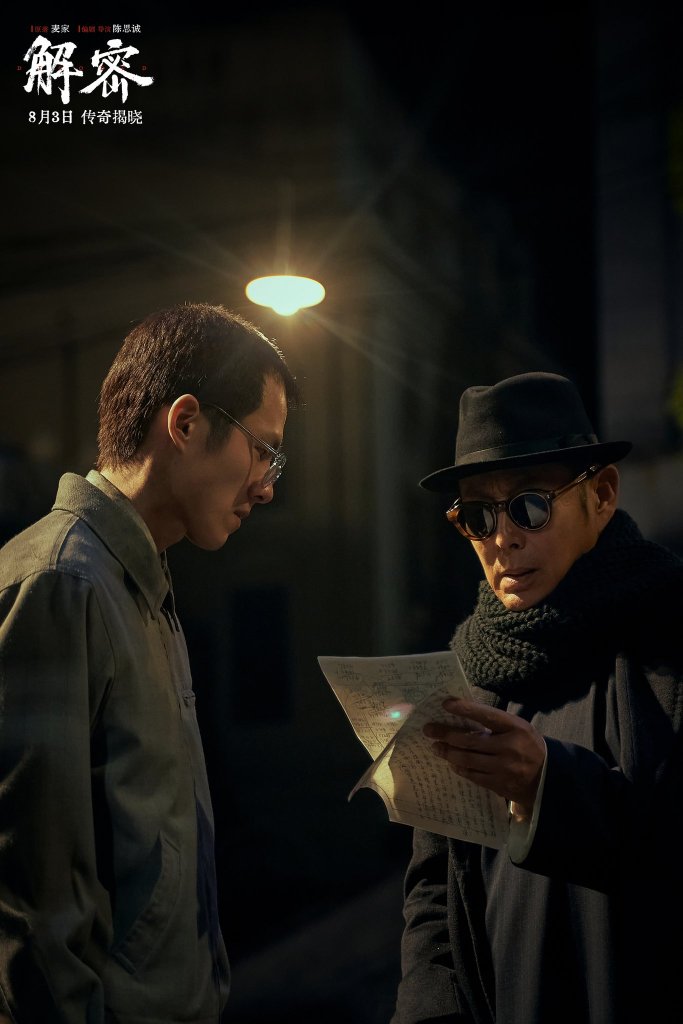
A well-shot, handsomely mounted straight-faced commercial drama, perhaps overly reminiscent of A Beautiful Mind, there would be little reason for westerners such as I to pay much mind to this nationalistic work, save one key element: American legend (or at least “local hero” to a generation) John Cusack returns to the cinema after a several-year absence in a film likely to be seen by nobody outside of China. Decoded is also Cusack’s first film in what feels like a thousand years not to feature him in an umpire outfit, dressed all in black, vaping and muttering most of his lines. As such, to quote Arthur Miller, “attention must be paid!”
Cusack Rising
Cusack is still compelling; I know only three people care at this point, but if you do care, he has a significant supporting role as Jinzchen’s Polish mentor and later adversary, Jan Liseiwicz. Whether or not Cusack’s recent absence is due to his vocal leftist politics which seem to overlap with a mounting apathy towards cinema (he’s taken largely thankless parts in inferior films for the better part of a decade, as if he’d simply given up in challenging himself), he seems to take this part seriously and does well by it.

Decoded’s nationalistic bent, however, doesn’t seem to jibe with Cusack’s leftist instincts. While one can imagine he’s ok with painting the U.S. government as a bunch of interfering agitators, I’m not sure he shares the film’s clear hostility towards Taiwan and its efforts to take Chinese territory and repurpose it for their own nefarious reasons. This isn’t my position, it’s the film’s, which has characters debate the nature of what “country” means, with both Cusack’s Liseiwicz (one surrogate father) and Daniel Wu’s Xianlili (another surrogate father) offering up possible definitions to Jinzchen. Unsurprisingly, Jinzchen ultimately adopts Xianlili’s patriotic definition.
I don’t know enough about modern Chinese filmmaking to really be sure about any of this, but while Sicheng’s film seems to take the position that Xianlili’s definition of country as “borders that need to be protected” as correct, fitting Chinese nationalistic propaganda, it would seem that Sicheng doesn’t disrespect Liseiwicz’s argument that country is “family and friends and those you love.” While Jinzchen unstintingly works to decipher various ciphers created by Liseiwicz, the film doesn’t ignore the fact that the work literally drives him mad, deprives him of family and friends, and makes him emotionally abuse his wife.

Nationalism With an Asterisk
Most interesting is the tug of war between Jinzchen and Liseiwicz; Liseiwicz makes “purple” and “black” ciphers that Jinzchen goes insane trying to decipher, but their bond means Liseiwicz keeps sending clues to Jinzchen to help him decode the ciphers, and Jinzchen and his boss Director Chen conspire privately to keep Liseiwicz from being blamed for conspiring with Jinzchen when Jinzchen ultimately does crack the cipher code, for fear the U.S. government will persecute him. Also, at one point, Jinzchen’s surrogate family are being beaten by fellow communists, accused of being “capitalists”; it’s Jinzchen’s personal intervention that keeps them alive, which question’s the film’s surface assertion that country comes first. “Good” countrymen like the communists assaulting Biyu, the girl Jinzchen grew up with (and another potential love denied by his service to his country) are hardly seen in the most positive light.
Still, let’s not overdo it, it is indeed a nationalistic work where the primary effort of its brilliant protagonist is to thwart the treasonous Taiwanese, and the U.S. government aiding them, in what the film clearly posits are acts of terror. Still, the film’s ambivalence is real, as the rather effective melancholic tone in its final act reminds one of all that has been lost by Jinzchen’s and Liseiwicz’s decades of constructing and deconstructing ciphers.
Boys With (Math) Toys
The film does muddle its nationalistic message well enough that we never quite forget that Liseiwicz and Jinzchen were once going to head off to M.I.T. to share a grand adventure solving math mysteries together (early on Liseiwicz calls math “art” and strongly cautions Jinzchen from getting involved in matters of state and war) before the Chinese government takes Jinzchen away from all he loves to serve his country. The film effectively dramatizes two great minds that are worn down playing endless war games against each other. By the end, both men are a shell of what they were when they were first united.
Decoded’s key cinematic hook is Jinzchen deciphering complex codes by analyzing his own (and Liseiwicz’s) vivid dreams, allowing for many vivid, perplexing CGI-driven dream sequences, and humorously a large part of the third act is Jinzchen trying to figure out why Liseiwicz has sent him a copy of the Beatles “I Am the Walrus.” The dream sequences make up a great part of the film, especially its climax, which is a good thing; it keeps the film from being a garrulous talking head drama, and Chen (best known as a comedy director) films these sequences imaginatively.
But the key takeaway is that John Cusack is still alive, still ostensibly interested in acting, and can still hold a screen. If you’ve been longing to see Cusack take a project seriously, sans vaping, then grab one of the Blurays being offered on eBay for under twenty bucks.
For the rest of society, just carry on, not much to see here.
But I know I’m not alone; having grown up as I on Better Off Dead, Say Anything, the Grifters and High Infidelity, fellow Cusackphiles are pulling out their credit cards as they read this.



 Tremble...Sigh...Wonder...
Leave a comment